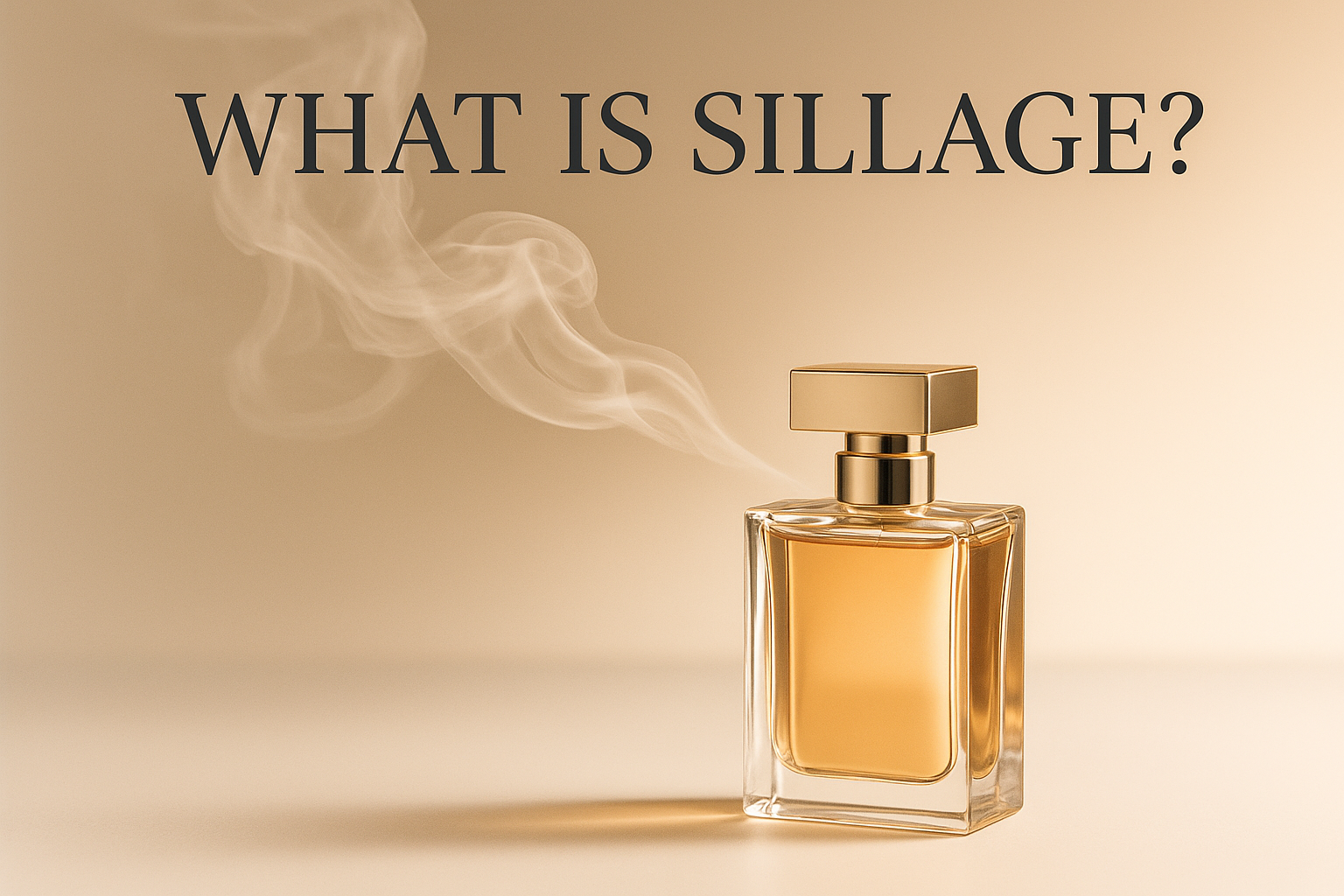
Of the three most-discussed performance terms in modern fragrance, sillage, projection, and longevity, sillage is the one most wearers describe wrong. It is not how strongly a fragrance projects in the first hour, and it is not how many hours the bottle lasts on skin. Sillage is the scent trail you leave behind when you walk out of a room, the olfactory shadow others smell after you have already moved on. Understanding the distinction is the difference between buying a fragrance you wear and a fragrance that other people remember you by.
Projection is what people smell while you are next to them. Sillage is what they smell after you have left. The two are correlated, but they are not the same thing.
- What it is: The scent trail a fragrance leaves in the air after the wearer moves through a space.
- What it is not: Not projection (radius around you now). Not longevity (hours on skin).
- What controls it: Composition density, concentration tier, dose, and skin chemistry, in roughly that order.
What sillage actually is
Sillage (pronounced see-yazh, from the French word for “wake,” as in the trail left by a boat) is the scent that lingers in the air after the wearer has walked through a space. It is the part of fragrance that other people experience independently of you, the olfactory cloud that says “someone wearing this perfume was here” after you have already left the room.
The clearest test for sillage is environmental rather than personal. If a colleague says “I knew you had arrived because I smelled your perfume in the hallway”, that is sillage describing itself accurately, they smelled the trail before they saw you. If a partner says “you smell incredible right now” while standing next to you, that is projection, not sillage. Sillage is what remains after you have moved on; projection is the radius of scent around you in real time.
The technical distinction matters because the two metrics respond to different formulation choices. A fragrance can have strong projection and weak sillage (sits loudly close to skin but does not travel, many fresh aquatics behave this way). It can also have moderate projection and exceptional sillage (does not blast on first sniff, but leaves an unmistakable trail through every room, this is the signature of well-made niche orientals). Understanding which behavior you actually want is the first decision in choosing a fragrance for the way you live.
Sillage vs projection vs longevity, the trio everyone confuses
These three terms get used interchangeably in casual fragrance conversation, but each describes a different physical behavior of the molecules on your skin. Projection is the radius of scent perceptible around you at a given moment, measured in inches or feet from the body. Longevity is the total wear time before the fragrance is no longer detectable on skin, measured in hours. Sillage is the persistence of scent in the ambient air after you move through it, measured by how long the trail remains noticeable in a room you have left.
A practical illustration: Dior Sauvage EDT projects loudly for the first two hours, then collapses close to skin for the rest of its 8-hour wear. High projection, moderate longevity, weak sillage past hour two. Parfums de Marly Layton projects more politely for the first hour, then settles into a steady moderate cloud for ten hours and leaves a trail in every room you walk through. Moderate projection, high longevity, exceptional sillage. Both are well-loved, but for completely different reasons. Confusing the two leads to disappointment when “high-projection” recommendations underwhelm in actual sillage performance.
The reason this matters at the retail counter: customers ask for “strong” fragrances, but the word “strong” hides which of the three metrics they actually care about. If you want compliments standing next to someone, project. If you want to be remembered after you leave, sillage. If you want one application to last a whole day, longevity. The best fragrances optimise for two of the three; very few optimise for all three at once, and the ones that do (Aventus, Black Phantom, Side Effect) are priced accordingly.
How sillage actually works on a molecular level
Sillage is the result of volatile aromatic molecules diffusing into the surrounding air faster than the air can disperse them. Every fragrance contains a mixture of molecules with different volatilities, top notes (citrus, aldehydes) evaporate fastest; middle notes (florals, spices) evaporate at moderate rates; base notes (musk, amber, woods) evaporate slowest. The trail you leave behind is composed primarily of middle and base notes, because top notes have already dissipated by the time you walk past someone.
This is why sillage feels different at hour one versus hour four. In the opening, you leave a complex multi-layered trail because every part of the composition is volatile at once. By hour four, the trail is quieter but more focused, only the slow-evaporating heart and base molecules are still leaving the skin in detectable quantities. Most fragrances actually produce cleaner sillage in the dry-down than in the opening, because the trail is no longer competing with the loud top accord.
Heat accelerates evaporation, which is why warm rooms, summer weather, and warm pulse points (wrist, neck, behind the ears) all amplify sillage. This is also why a fragrance that performs subtly in a cold winter office can become overwhelming in a heated restaurant. The same dose, the same skin, the same molecules, but a 10°C ambient temperature difference can double the evaporation rate, and therefore the sillage intensity.
What actually controls sillage on skin
Four variables determine how much sillage a fragrance will produce on you, in roughly this order of importance. Composition density, fragrances built around naturally diffusive molecules (oud, ambroxan, civet, certain musks, benzoin, labdanum) project further into ambient air than fragrances built around close-to-skin materials (clean musks, soft woods, transparent florals). This is set by the perfumer at formulation time and cannot be changed by the wearer.
Concentration tier matters next. An EDP or Parfum at 18-25% perfume oil produces more sillage than the EDT version of the same composition at 8-12%, all else equal. This is partly volume (more aroma molecules per spray) and partly because higher-concentration formats use more fixatives that hold molecules to skin longer, producing a steadier slow-release trail rather than a quick burst.
Application dose and placement are the variables you control directly. Three sprays produce more sillage than one, but the relationship is not linear; doubling the dose does not double the trail. The marginal sillage from each additional spray decreases sharply after about four sprays for most compositions. Placement matters more than count: pulse points (neck, wrists, inner elbows) generate higher sillage than torso application because they are warmer and therefore evaporate faster. Spraying onto clothing produces less sillage than skin in the short term but more in the very long term, because fabric holds molecules longer than skin chemistry permits.
Skin chemistry is the wildcard. Skin pH, sebum composition, hydration level, and recent diet (garlic, alcohol, spice) all affect how aroma molecules interact with the body and therefore how they evaporate. The same fragrance can produce dramatically different sillage on two different wearers, which is why the question “does this fragrance have good sillage?” is incomplete without the follow-up “on whom?”
How to test your own sillage at home
The most reliable way to measure your sillage is environmental rather than self-perceived, you cannot accurately judge your own trail because your nose adapts to your scent within minutes of application, a phenomenon called olfactory fatigue. The trick is to use a separate, untreated reference space.
The room test: apply your normal dose of fragrance and wait five minutes for the top notes to settle. Walk into a room you have not previously occupied that day, a kitchen, a bathroom, a meeting room. Stand in the centre for fifteen seconds, then leave. Wait one hour, then return. If you can clearly smell your fragrance in the air upon re-entering, you have strong sillage. If the room smells normal, you have moderate-to-light sillage. If you cannot detect any trace, your sillage on your current skin chemistry is light, which is not bad, but it tells you the fragrance is performing as a personal scent rather than as a presence-projector.
The companion test: ask someone who lives with you to walk through a room ten minutes after you have passed through it and tell you what they smell. Their nose has not adapted to your scent, so their report is more accurate than your own. If they immediately identify the fragrance, your sillage is strong. If they say “I can smell something but I cannot tell what it is”, your sillage is moderate. If they say nothing, the trail does not extend that far. Repeat with the same fragrance on different days to control for ambient temperature and skin variability, sillage varies day-to-day more than most wearers realise.
Curious why so many modern fragrances feel similar in the dry-down?
The structural molecule responsible for the soft, radiant aura of most post-2010 designer fragrances is Iso E Super, a synthetic aroma chemical that explains why Sauvage, Bleu de Chanel, Terre d’Hermès, and dozens of others share a recognisable warm haze in the late dry-down. Read the Iso E Super guide →
7 fragrances with exceptional sillage, ranked by trail strength
Seven compositions where sillage is the defining performance characteristic, ordered from most-extreme projector to most-elegant trail. Every one has been tested at the niche counter and worn through full days. None are subtle; all of them announce themselves.
| Fragrance | Brand | Concentration | Role | Verdict |
|---|---|---|---|---|
Aventus View on Amazon → | Creed | EDP | The reference | The canonical high-sillage masculine. 2010 release that defined the modern projector category, pineapple-smoke trail visible across a room. |
Side Effect View on Amazon → | Initio Parfums Privés | EDP | Niche beast | Tobacco-rum-cinnamon composition built specifically for projection. Two sprays clear an elevator. Reapplication is almost never needed. |
Black Phantom "Memento Mori" View on Amazon → | Kilian | EDP | Gourmand projector | Coffee-rum-almond density that travels six feet behind you for the first three hours. Holds an audible trail at hour eight. |
Layton View on Amazon → | Parfums de Marly | EDP | Iconic | The most polite-yet-unmistakable trail in the PdM lineup. Apple-violet-vanilla cloud lasts ten hours and leaves a clean, refined sillage in every room. |
Khamrah Qahwa View on Amazon → | Lattafa | EDP | Budget niche | Coffee-cinnamon-cardamom projection at $30. Genuinely competes with niche bottles five times the price for first-three-hour sillage. |
Erba Pura View on Amazon → | Xerjoff | EDP | Foundation | Citrus-fruit-vanilla density that creates a remarkably loud-yet-clean sillage. The unisex compliment magnet at the niche counter for a reason. |
Black Opium Le Parfum View on Amazon → | Yves Saint Laurent | Parfum | Modern feminine | Coffee-vanilla-jasmine density that creates the loudest sillage in the YSL lineup. The Le Parfum tier is meaningfully stronger than the original EDP. |
“A fragrance that does not leave a trail is a fragrance no one will ever describe back to you, and being described back to yourself is half the reason any of us wear perfume in the first place.
Rodrigo H. · Counter Notes
Sillage is the metric that turns “I wear a nice fragrance” into “I am the person who wears that fragrance.” It is what makes a scent recognisable across a room, memorable after you have left, and ultimately attached to you as part of how others identify you. Projection wins compliments; longevity saves you reapplications; sillage is what gets you remembered.
The seven bottles in the table above are all genuinely high-sillage performers, but pay attention to which behaviour each one delivers. Side Effect and Black Phantom are loud-and-immediate; you will know they project the moment you spray them. Layton and Erba Pura are polite-but-persistent; they do not announce themselves on application but produce hours of clean, drifting trail. Decide which mode of sillage actually fits the way you live before spending niche-tier money on either.
Common questions
+How is sillage different from projection?
Projection is the radius of scent around you in real time, what people standing next to you smell. Sillage is the trail of scent left in the air after you have moved through it, what people smell after you have already walked past. A fragrance can have strong projection and weak sillage (loud close, no trail), or moderate projection and exceptional sillage (does not blast, but follows you everywhere).
+Which fragrance concentrations have the best sillage?
Generally, EDP and Parfum (Extrait) concentrations produce more sillage than EDT, all else equal, partly because of higher oil concentration, partly because higher-tier formats use more fixatives that hold the trail steady. That said, composition matters more than concentration. A well-made EDT (Sauvage EDT, Acqua di Giò Profumo EDT) can outperform a poorly-made Parfum on sillage. Use concentration as a starting filter, not a final answer.
+Can I improve the sillage of a fragrance I already own?
Within limits, yes. Spray on warm pulse points (back of neck, inner elbows) rather than torso. Use slightly more product than you think you need, most wearers under-apply by 30-50%. Layer with an unscented moisturiser before spraying; hydrated skin holds aroma molecules longer, producing more steady sillage. And spray on clothing as well as skin, fabric extends sillage by hours, especially wool and cotton. None of these tricks turn a low-sillage fragrance into a beast, but they can recover 20-40% more trail from compositions that are projecting under their potential.
+Why does my fragrance have great sillage on some days and almost none on others?
Skin chemistry varies day-to-day more than most wearers realise. Skin pH, sebum production, hydration, recent diet, and ambient temperature all affect how aroma molecules evaporate from skin. A 10°C swing in room temperature roughly doubles or halves evaporation rate, and therefore sillage intensity. Diet, particularly garlic, alcohol, and certain spices, affects sebum chemistry and can mute fragrance for 24-48 hours after consumption. The same bottle, the same dose, the same skin: but the variables underneath the skin shift constantly.
+Are oud-based fragrances always high-sillage?
Real oud (agarwood) is one of the most diffusive natural materials in perfumery, so fragrances built around it tend to have strong sillage by default. But “oud” on a note pyramid does not mean real oud, most mainstream “oud” fragrances use synthetic oud accords (oud beta, oud assilim, etc.) which are cleaner but less diffusive. A genuine oud composition (Tom Ford Oud Wood, Aventus, Khamrah, Initio) will sillage strongly. A synthetic-oud designer fragrance often has cleaner-but-quieter projection. The note name does not predict the sillage, the formulation does.
+Can a fragrance have too much sillage?
Yes, context matters. A two-spray dose of Side Effect or Black Phantom is appropriate for an evening dinner; the same dose in a small office at 9am is rude to colleagues. The most-cited fragrance etiquette rule is the “elevator test”: if your sillage is detectable to someone who steps into an elevator with you, that is fine for social settings; if it is detectable five minutes after you have left the elevator, you have over-applied for daytime professional use. High-sillage fragrances need dose discipline more than low-sillage ones.
 Education
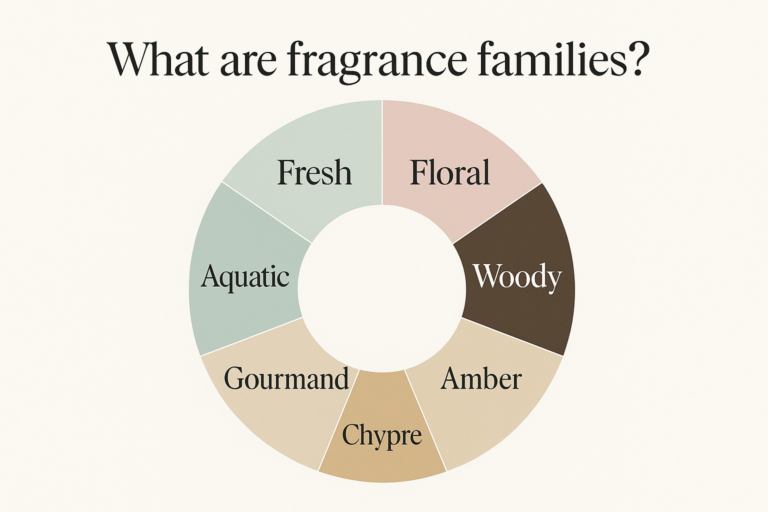
What Are Fragrance Families? A Simple Guide for Beginners
Read more →
How To Know Which Season A Fragrance Is Designed For
Read more → Education
What Is Ambroxan in Perfumery? A Complete Guide
Read more → Education
What Is Musk in Perfumery? History, Smell and Types
Read more → Education
Iso E Super in Perfumery: A Guide to the Ghost ingredient
Read more →
Scent Chronicles participates in affiliate programs. We may earn a commission on qualifying purchases made through links in this guide, at no additional cost to you. This never affects which fragrances we recommend or what we say about them. Read full policy →