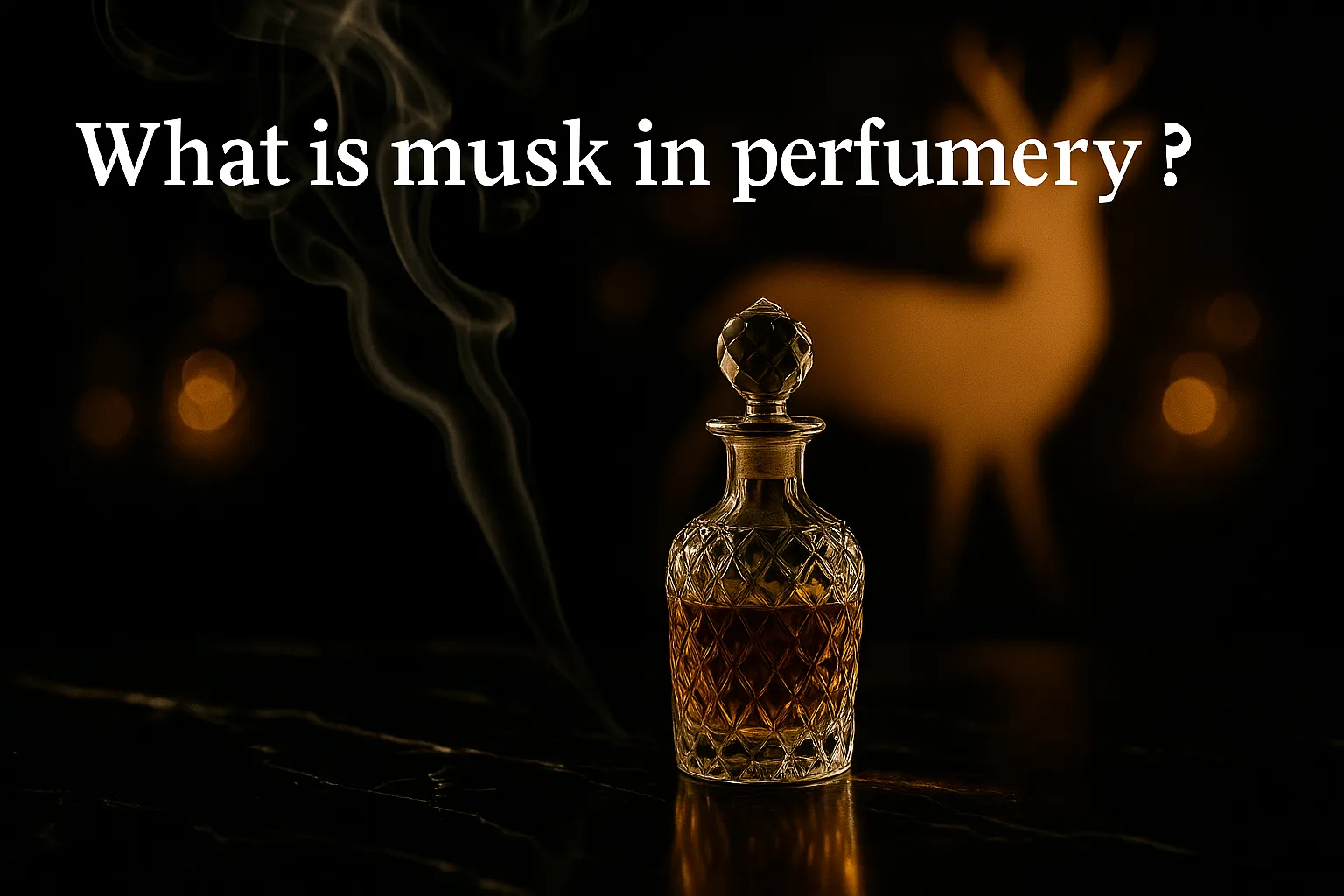
Musk is the most-used base-note fixative in modern perfumery, but the term covers a complicated category. Originally referring to the glandular secretion of male musk deer (a now-banned natural ingredient), modern musk in commercial perfumery is almost exclusively synthetic. A family of approximately 200 different molecules that produce the warm-skin-soft-clean character that anchors most contemporary fragrance compositions. Understanding modern musk is understanding why so many perfumes share a similar “clean” base architecture.
Modern musk is a family of synthetic molecules. Natural musk deer harvest has been banned since 1979.
- What it is: A family of ~200 synthetic molecules producing warm-skin-soft-clean character.
- Where it lives: Almost every modern fragrance. Typically 5-25% of total composition by weight.
- Why it matters: Anchors longevity, smooths volatility, and produces the “clean” base of modern compositions.
What musk actually is
Musk originally referred to the glandular secretion of male Moschus moschiferus deer, native to the Himalayan regions of South and Central Asia. Natural musk was harvested by killing the male deer to extract the gland. A process that drove musk deer populations to near-extinction by the 20th century. Natural musk harvest has been banned under CITES since 1979, though small quantities of legacy natural musk still circulate in luxury Middle Eastern perfumery.
Modern commercial perfumery uses synthetic musks almost exclusively. The category includes approximately 200 different molecules grouped into four main families: nitromusks (largely banned due to safety concerns), polycyclic musks (Galaxolide, Tonalide), macrocyclic musks (Muscone synthetic, Civetone synthetic), and alicyclic musks (Helvetolide, Romandolide). Different musk families produce different aromatic profiles. Galaxolide reads clean-laundry-soap; macrocyclic musks read warmer and more skin-like; alicyclic musks read between the two.
In commercial perfumery, “musk” rarely refers to a single ingredient. Most modern fragrances use blends of 5-15 different musk molecules calibrated to produce specific architectural effects. The term “white musk” specifically refers to musk blends emphasising the cleaner, more soap-coded synthetic family (Galaxolide, Habanolide, Helvetolide). The term “black musk” or “animalic musk” refers to musk blends emphasising warmer, more skin-coded molecules (Muscenone, Civetone synthetics).
How musk behaves on skin
On skin, musk produces a warm-soft-clean character that develops slowly across the entire wear arc. Most musk molecules are heavy base-note fixatives that anchor compositions for 8-24 hours and amplify surrounding notes without dominating them. The category-defining behaviour is “skin-like” warmth. Musk-heavy compositions feel as if they have merged with the wearer rather than sitting on top of skin.
Skin chemistry affects musk expression more dramatically than most synthetic aromatic categories. Different musk molecules interact with skin sebum in different ways, which is why two people wearing the same musk-heavy composition can produce noticeably different impressions hours into wear. Some wearers experience musks as cleaner and more soap-coded; others experience them as warmer and more animalic. This is also why musk-heavy compositions are so polarising. Wearer reactions vary more than for traditional natural-material compositions.
Musk anosmia is the most-documented anosmia phenomenon in perfumery. Approximately 5-15% of the population experiences reduced sensitivity to specific musk molecules, particularly nitromusks and certain macrocyclic musks. Most affected individuals can still smell other musk families, which is why modern compositions blend multiple musks for cross-population coverage. Pregnant women experience temporary heightened sensitivity to musk; some perfumes that read clean to baseline wearers can read overpowering during pregnancy.
A short history of musk in perfumery
Natural musk has been used in perfumery, medicine, and ceremonial contexts in South and Central Asia for over two thousand years. The Western perfumery industry imported natural musk from the 16th century onward, and it became one of the four classical animal-derived base-note fixatives (alongside ambergris, civet, and castoreum) used in pre-20th-century luxury perfumery.
The first major synthetic musk was Musk Baur (Albert Baur, 1888). A nitromusk derived accidentally during research into trinitrotoluene synthesis. Through the early 20th century, several nitromusks (Musk Baur, Musk Ambrette, Musk Ketone, Musk Xylene) became commercial standards in soap, cosmetics, and fragrance. Most nitromusks were banned in the 1990s after toxicological studies identified neurological and environmental safety concerns; modern commercial perfumery uses primarily polycyclic and macrocyclic synthetic musks.
The post-2000 era has seen the rise of “clean musk” compositions as a dominant feminine perfumery category. Brands like Jo Malone, Glossier, Maison Margiela Replica, and Phlur built entire commercial identities around minimal-musk-anchored compositions that emphasise the clean-skin-soft character of modern synthetic musks. Today, musk appears in essentially every modern fragrance. Typically 5-25% of total composition by weight, depending on architectural emphasis.
How to recognize musk on skin
The fastest way to learn what musk smells like is to wear a musk-forward composition for a day. Glossier You, Narciso Rodriguez For Her Pure Musc, and Maison Margiela Replica Lazy Sunday Morning all use synthetic musks at concentrations high enough to be reference-able in isolation. The cleanest reference is to compare two compositions: a clean-musk feminine (Glossier You) versus an animalic-musk niche (Kiehl’s Original Musk). The clean-musk reads soap-and-fresh-laundry; the animalic-musk reads skin-warm-intimate.
In compositions where musk plays a supporting role, you can usually identify it by behavioural pattern. The dry-down has a “skin-like” quality that observers describe as natural rather than perfume-coded; longevity exceeds what the listed concentration would predict; the projection has a soft warmth that increases over the first two hours. Most modern designer compositions in current production rely on musk for this supporting-anchor role.
Distinguishing between clean musk and animalic musk takes a developed nose. Clean musks read as fresh-laundry, soap, and “shower-fresh”; animalic musks read warmer, more skin-intimate, and slightly sweet. Most modern compositions blend both for architectural balance. Buyers who specifically prefer one or the other end can build rotations accordingly. Clean-musk for office and warm-weather wear, animalic-musk for evening and cold-weather rotations.
Want to understand another defining synthetic?
If musk is the soft-clean-skin backbone of modern perfumery, ambroxan is the salty mineral-warm counterpart that has dominated mainstream designer perfumery since 2010. The two molecules together account for the structural backbone of post-2015 commercial composition. Read the Ambroxan guide →
Fragrances featuring musk, ranked by how prominently it shows
Five well-known compositions where musk plays a real structural role, ordered from most-prominent showcase to most-effective supporting role.
| Fragrance | Brand | Concentration | Role | Verdict |
|---|---|---|---|---|
Glossier You View on Amazon → | Glossier | Heavy | Clean musk showcase | The clean-musk reference. Iris-pink-pepper-musk skin-warmth. |
For Her Pure Musc View on Amazon → | Narciso Rodriguez | Heavy | Animalic-clean blend | The mainstream musk-anchored designer. Floral-musk-amber. |
Lazy Sunday Morning View on Amazon → | Maison Margiela Replica | Significant | Clean-laundry musk | White-musk-aldehyde clean composition. The soap-and-fresh-laundry reference. |
Original Musk View on Amazon → | Kiehl's | Heavy | Animalic musk reference | The warm-skin-animalic musk. The closest mainstream composition to natural musk profile. |
Sweet Tooth View on Amazon → | Sabrina Carpenter | Significant | Gourmand-musk anchor | Cotton-candy-vanilla anchored on white musk for clean dry-down. |
“Modern musk is a family of synthetic molecules. Natural musk deer harvest has been banned since 1979.
Rodrigo H. · Counter Notes
Musk is the most architecturally significant aromatic category in modern perfumery and the least-understood by buyers. The category includes approximately 200 different molecules with meaningfully different profiles, which is why “musk” can mean clean-laundry-soap (Glossier You) or warm-skin-intimate (Kiehl’s Original Musk) within the same broad term.
For most buyers, the right musk strategy is to identify whether you prefer clean-musk or animalic-musk dry-downs, then build rotations accordingly. Clean-musk wearers should look at Glossier You, Maison Margiela Replica Lazy Sunday Morning, Narciso Rodriguez For Her. Animalic-musk wearers should look at Kiehl’s Original Musk, Serge Lutens Muscs Koublaï Khän, Le Labo Musc 25. Most rotations include both ends for seasonal versatility.
Common questions
+What does musk smell like?
Modern synthetic musks produce a warm-soft-clean character that ranges from soap-and-fresh-laundry (clean musks like Galaxolide) to warm-skin-intimate (animalic musks like Muscenone). The cleanest reference is to wear a musk-forward composition like Glossier You or Narciso Rodriguez For Her Pure Musc.
+Is natural musk legal?
Natural musk deer harvest has been banned under CITES since 1979. Small quantities of legacy natural musk still circulate in luxury Middle Eastern perfumery, but commercial perfumery uses synthetic musks exclusively. The natural-versus-synthetic distinction in modern musk is largely academic; even niche-tier compositions use synthetic musks almost exclusively.
+Why are some people anosmic to musk?
Different musk molecules bind to different olfactory receptors, and genetic variation affects how individuals perceive specific musk types. Approximately 5-15% of the population is anosmic to certain musk molecules. Most commonly to specific nitromusks (now largely banned) and to certain macrocyclic musks. Modern compositions blend multiple musks across families to compensate for population-level anosmia coverage.
+What is the difference between white musk and black musk?
White musk refers to clean-laundry-soap musk profiles emphasising synthetic molecules like Galaxolide, Habanolide, and Helvetolide. Black musk (or animalic musk) refers to warmer, more skin-coded musk profiles emphasising Muscenone, Civetone synthetics, and other macrocyclic musks. The “white” and “black” labels are marketing conventions rather than scientific terms. There is no single “white musk” or “black musk” molecule.
+Are musk fragrances appropriate for office wear?
Generally yes, particularly clean-musk compositions. White-musk feminine compositions (Glossier You, Maison Margiela Replica Lazy Sunday Morning, Narciso Rodriguez For Her) are office-appropriate by design. Animalic-musk compositions (Kiehl’s Original Musk, Serge Lutens Muscs Koublaï Khän) skew more evening-coded and intimate. For office contexts, prioritise clean-musk over animalic-musk in most cases.
+Can men wear musk fragrances?
Yes. Musk has been used across genders since perfumery began, and modern men’s designer fragrances rely heavily on musk for base-note structure. Specifically musk-anchored compositions like Yves Saint Laurent Y EDP, Tom Ford Tobacco Vanille, and Maison Margiela Replica By the Fireplace all read fully masculine in wear. The “feminine” association of clean-musk descends from 1990s marketing positioning rather than from anything inherent to the category.
 Education
What is Sillage in Perfumery? Definition and Meaning
Read more →
How To Know Which Season A Fragrance Is Designed For
Read more → Education
What is Vanilla in Perfumery? A Guide to the Sweetest Note
Read more →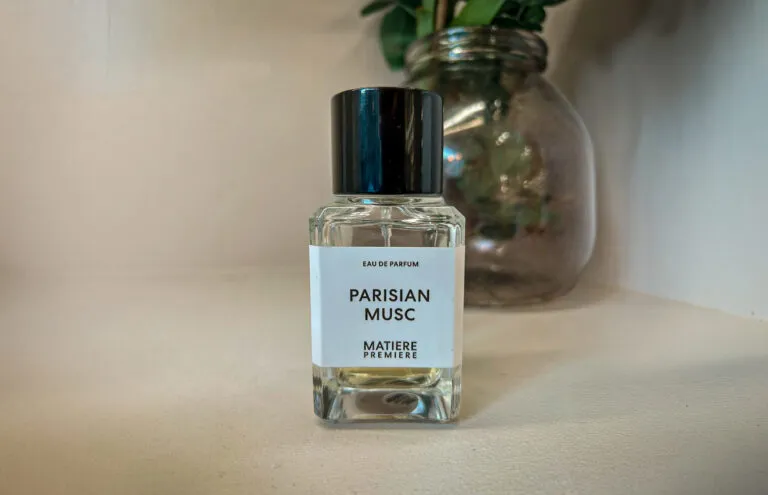
Matière Première Parisian Musc Review: Minimal, Urban Elegance
Read more → Education
Iso E Super in Perfumery: A Guide to the Ghost ingredient
Read more →
Scent Chronicles participates in affiliate programs. We may earn a commission on qualifying purchases made through links in this guide, at no additional cost to you. This never affects which fragrances we recommend or what we say about them. Read full policy →