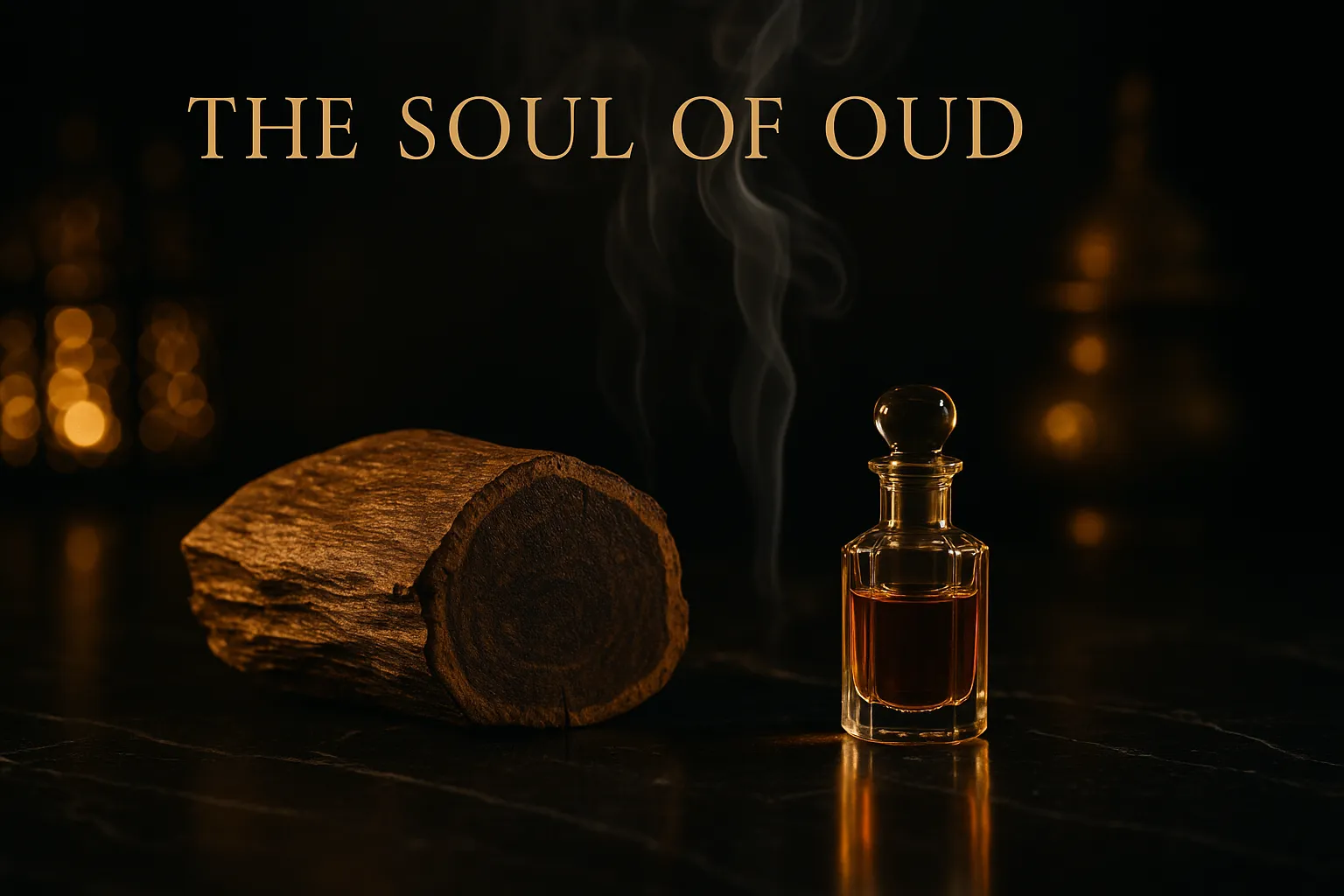
Oud is the resinous heartwood of the Aquilaria tree, produced when the tree is infected by a particular mould. The infection turns the surrounding wood dark, dense, and saturated with aromatic compounds. A process the tree uses defensively, but one that has built an entire global perfumery category. Understanding oud is understanding why fragrance houses charge $400+ for compositions where the ingredient is named on the bottle, and why most “oud” fragrances at the designer-tier level contain almost no real oud at all.
Oud is the rarest commercially-traded perfumery ingredient. Most “oud” fragrances at the designer tier contain almost none.
- What it is: Resinous heartwood from infected Aquilaria trees, native to South and Southeast Asia.
- Why it costs so much: Only ~2% of wild trees produce usable resin. The harvest cycle takes 10-15 years.
- Where it lives: Initio Oud for Greatness, Tom Ford Oud Wood, MFK Oud Satin Mood, and the entire Middle Eastern attar tradition.
What oud actually is
Oud, also called agarwood, oudh, or aloeswood, is a dense, resinous wood that forms inside species of the Aquilaria tree when the tree is infected by a particular mould (Phaeoacremonium parasitica or related fungi). The infection causes the heartwood to produce a defensive resin saturated with aromatic compounds. Over years to decades, the affected wood darkens, hardens, and develops the smoky-leathery-resinous character that perfumery prizes.
Aquilaria is native to South and Southeast Asia. Primarily India, Bangladesh, Bhutan, Myanmar, Laos, Cambodia, Thailand, Vietnam, Malaysia, Indonesia, and the Philippines. Different geographic origins produce different oud profiles: Indian oud (often called Hindi oud) is barnyard-leathery, Cambodian oud is sweeter and more honeyed, and Indonesian oud sits in between with smokier dry-down character. These regional differences matter to oud connoisseurs the way single-malt regions matter to whisky drinkers.
In commercial perfumery, the term “oud” is used loosely. True oud essential oil, produced by steam-distilling the infected wood, costs $30,000-80,000 per kilogram depending on origin and quality. This is why most designer-tier fragrances using “oud” in their name actually contain synthetic oud reconstructions, oud accord blends, or trace amounts of natural oud combined with much larger volumes of synthetic woody amber molecules. True natural oud at perceptible concentrations is mostly limited to niche-tier and Middle Eastern attar markets.
How oud behaves on skin
On skin, oud is one of the most chemistry-dependent ingredients in modern perfumery. The natural resin contains over 200 identified aromatic compounds, and skin sebum interacts with each of them differently. Meaning two people wearing the same oud-forward composition can smell remarkably different fragrances within the first hour of wear.
Real oud projects with a distinctive resinous, leathery, slightly fermented character that can read as polarising on first encounter. The opening is often described as “barnyard”, earthy and animalic, particularly in Hindi-style oud compositions. The dry-down softens and sweetens over six to twelve hours, eventually producing a warm, smoky-honeyed character that has been the architectural anchor of Middle Eastern perfumery for centuries.
Synthetic oud reconstructions behave very differently. They tend to skip the polarising opening entirely and present immediately as a warm, smoky-woody profile that is more universally palatable but architecturally simpler. The dry-down also tends to be cleaner and shorter, holding for four to eight hours rather than the twelve-plus typical of real oud. For first-time buyers, synthetic oud compositions are the right entry point; real oud compositions are the right next step once your nose has built reference points.
A short history of oud in perfumery
Oud has been used in religious, medicinal, and personal-fragrance contexts in South Asia and the Middle East for over two thousand years. Sanskrit and ancient Chinese texts both reference agarwood as a ceremonial incense, and Islamic perfumery traditions have used oud extracts and oud-anchored attar compositions continuously since at least the 9th century.
The Western perfumery industry largely ignored oud until the early 2000s. The first major Western luxury release was Yves Saint Laurent M7 (2002), a Tom Ford-era YSL composition that placed oud explicitly in the front of the fragrance and marketed it as a luxury Middle Eastern import. M7 was commercially under-supported at the time but is now recognised as the bottle that opened Western perfumery to oud as a category.
The post-2010 explosion came from two specific releases. Tom Ford Oud Wood (2007) made oud accessible to luxury Western buyers as a soft-woody composition with synthetic oud reconstructions; Initio Oud for Greatness (2018) became one of the most-requested niche fragrances of the post-2018 market and introduced a new generation of buyers to oud-forward compositions. Today oud appears across the entire price spectrum from $35 Lattafa releases to $5,000+ niche-tier real oud attars.
How to recognize real oud
The fastest way to learn what real oud smells like is to wear a Middle Eastern attar at concentration. Brands like Ajmal, Swiss Arabian, and Mancera produce attars and concentrated oud compositions in the $50-300 price range that contain meaningfully higher percentages of real oud than any Western designer alternative. Wear one for a day to build a reference, then revisit Western “oud” compositions to recalibrate what the synthetic versions smell like.
In commercial Western fragrances, real oud at perceptible concentrations is usually identifiable by three behavioral patterns: a polarising or animalic opening (lasting 10-30 minutes), a complex middle phase that develops differently across skin chemistries (lasting two to four hours), and a long warm-smoky dry-down (six to twelve hours). Synthetic oud compositions tend to skip the polarising opening, develop more linearly through the middle phase, and dry down shorter and cleaner.
For buyers shopping niche, Initio Oud for Greatness and MFK Oud Satin Mood both contain higher real-oud concentrations than typical designer compositions but blend with significant synthetic woody amber to soften the polarising opening. For real oud at full concentration, look at single-origin attars from specialist Middle Eastern retailers like Sultan Pasha or Ensar Oud. The price ranges shift dramatically. A 3ml attar of Cambodian oud can cost $200-500, while equivalent volume of Hindi oud can cost $1,000-3,000.
Want to understand another defining ingredient?
If oud is the most expensive natural ingredient in modern perfumery, ambroxan is its synthetic counterpart. The salty mineral-warm molecule that has dominated mainstream designer perfumery since 2010 and serves as the structural backbone for the modern “oud-adjacent” Middle Eastern designer category. Read the Ambroxan guide →
Fragrances featuring oud, ranked by how prominently it shows
Five well-known compositions where oud plays a real structural role, ordered from most-prominent showcase to most-effective supporting role.
| Fragrance | Brand | Concentration | Role | Verdict |
|---|---|---|---|---|
Oud for Greatness View on Amazon → | Initio | Heavy | Niche showcase | The Western niche-tier oud reference. Saffron-lavender opens onto a oud-amber base. |
Oud Satin Mood View on Amazon → | Maison Francis Kurkdjian | Significant | Niche polished | Rose-violet opening into oud-vanilla heart. The smoothest niche oud composition in production. |
Oud Wood View on Amazon → | Tom Ford | Moderate | Luxury softened | The accessible Western oud entry. Synthetic oud reconstruction over sandalwood-vanilla base. |
Khamrah Dukhan View on Amazon → | Lattafa | Moderate | Budget entry | Smoky-incense composition with oud-adjacent base. Under $50 and broadly capable. |
Bade'e Al Oud Amethyst View on Amazon → | Lattafa | Significant | Middle Eastern designer | The Bade'e Al Oud line is the most oud-forward Lattafa range. Genuine oud accord at $40. |
“Oud is the rarest commercially-traded perfumery ingredient. Most “oud” fragrances at the designer tier contain almost none.
Rodrigo H. · Counter Notes
Oud is one of the most genuinely complex ingredients in modern perfumery, and one of the few where natural-versus-synthetic distinction matters in a perceptible way. For most Western buyers, synthetic oud compositions like Tom Ford Oud Wood and Initio Oud for Greatness are the right entry points. They capture the architectural shape of oud in a more universally-palatable form than real oud, and they hold their compositional character better in everyday wear.
For buyers ready to move beyond synthetic oud, Middle Eastern attar specialists offer a category-different experience. The price tier is significant ($200-3,000+ for small volumes of single-origin oud) but the educational value of smelling real oud at full concentration is real. Build the reference points first; spend the money second.
Common questions
+What does oud smell like?
Real oud smells resinous, leathery, smoky, and slightly fermented or animalic in the opening. The dry-down softens to a warm-honeyed wood with smoky undertones. Different geographic origins produce different profiles: Hindi oud is most barnyard-leathery, Cambodian oud sweetest and most honeyed, Indonesian oud smokiest. Synthetic oud is usually a softer, sweeter, more palatable interpretation of the same architectural shape.
+Is real oud worth the price?
For most Western buyers, no. Synthetic oud compositions like Tom Ford Oud Wood and Initio Oud for Greatness produce more universally-wearable compositions at significantly lower prices. Real oud is worth the investment for collectors, oud-specific enthusiasts, and buyers who have already built reference points through niche-tier synthetic oud compositions.
+Why is oud so expensive?
Three reasons. First, only about 2% of wild Aquilaria trees produce usable resin. The mould infection that causes resin formation is rare. Second, the harvest cycle takes 10-15 years for natural infection or 5-7 years for cultivated infection. Third, distilling oud essential oil requires several kilograms of resin-saturated wood to produce a small volume of oil. The result: real oud essential oil costs $30,000-80,000 per kilogram in commercial-grade purity.
+How can I tell if a fragrance contains real oud?
In commercial Western fragrances, look for a polarising or animalic opening (lasting 10-30 minutes), a complex middle phase that develops differently across skin chemistries, and a long warm-smoky dry-down (six to twelve hours). Synthetic oud compositions tend to skip the polarising opening and develop more linearly. For full reference: wear a Middle Eastern attar at concentration to build a baseline.
+Is oud sustainable?
Wild oud harvesting has historically been unsustainable. Aquilaria malaccensis was listed under CITES Appendix II in 1995 and Aquilaria crassna in 2004 due to over-harvesting. Modern commercial oud increasingly comes from cultivated Aquilaria plantations, particularly in Cambodia, Vietnam, and Bangladesh, where trees are deliberately inoculated with the resin-causing fungi. Cultivated oud is more sustainable but typically produces lighter, less-complex resin than wild-harvested oud.
+What is the difference between oud, agarwood, and aloeswood?
Three names for the same material at different processing stages. Agarwood is the raw resin-saturated wood. Oud (or oudh, ud) is the Arabic name and refers to either the wood or the distilled essential oil. Aloeswood is an older Western term largely interchangeable with agarwood. In modern perfumery, the distilled essential oil is typically called oud regardless of regional origin.
 Education
What Is Saffron in Perfumery? The Golden Spice of Fragrance
Read more → Education
What Is Ambroxan in Perfumery? A Complete Guide
Read more → Education
Perfume Layering: The Complete Guide
Read more → Occasion
Best Fall Perfumes for Women: Top 5 Picks for 2026
Read more → Education
Iso E Super in Perfumery: A Guide to the Ghost ingredient
Read more →
Scent Chronicles participates in affiliate programs. We may earn a commission on qualifying purchases made through links in this guide, at no additional cost to you. This never affects which fragrances we recommend or what we say about them. Read full policy →