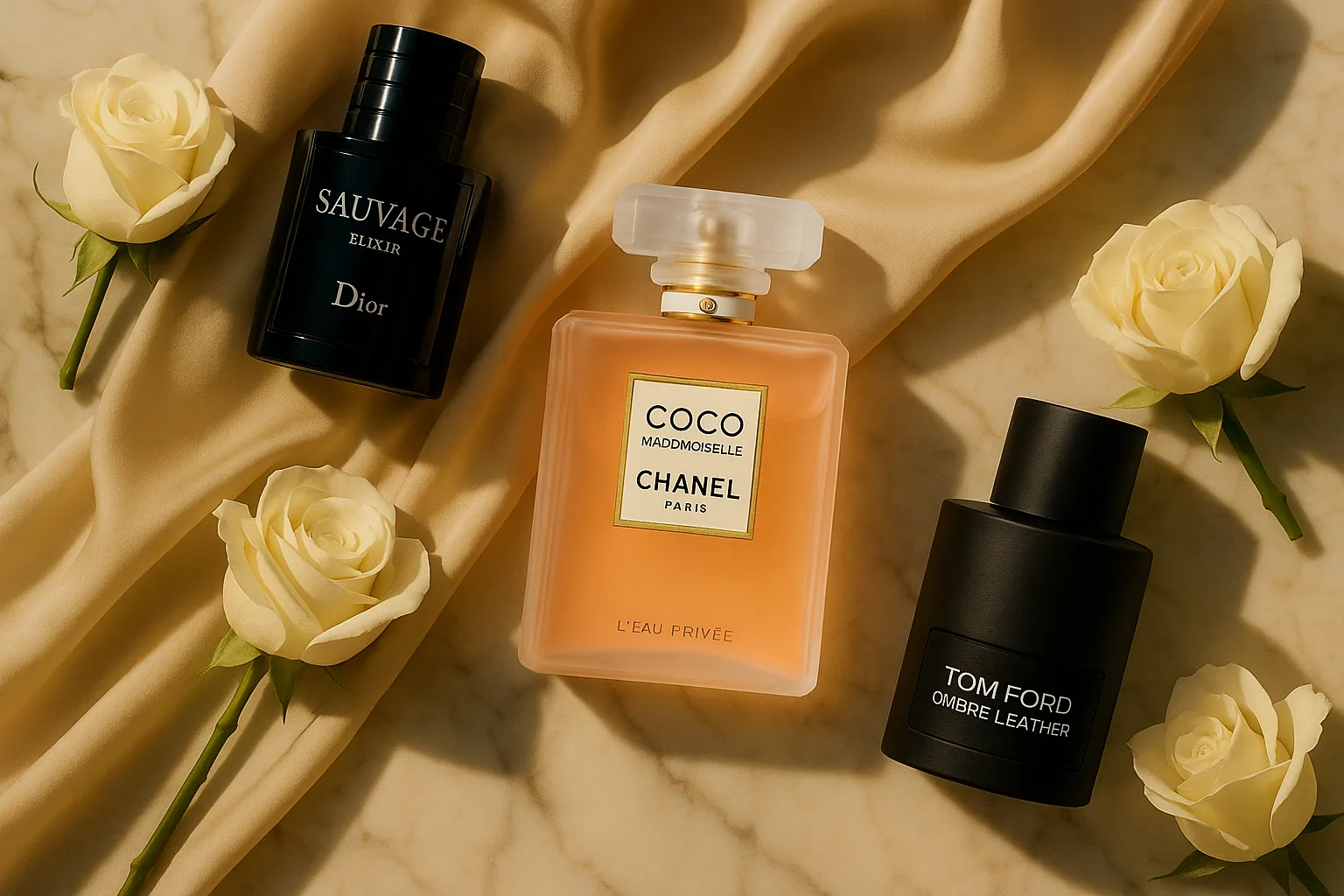
Most fragrances last meaningfully longer with the right application practice than with default approaches. The five techniques below are the framework I use at the niche counter to help buyers maximise wear duration without buying more concentrated bottles. None of them require special equipment; all of them are free; together they typically extend fragrance longevity by 30-100% over default application.
Most fragrances last 30-100% longer with the right application practice. The techniques are free.
- Technique 1: Apply to moisturised skin, not dry skin.
- Technique 2: Spray on pulse points and clothing for combined projection.
- Technique 3: Match composition concentration to expected wear duration.
Why fragrance fades on skin
Fragrance “fading” is the natural process of aromatic compounds evaporating from skin into the surrounding air. The rate of evaporation depends on three primary factors: molecular weight (lighter molecules evaporate faster), skin chemistry (sebum and hydration affect dwell time), and ambient conditions (temperature, humidity, air movement). The development arc of a fragrance. Top notes lasting 10-30 minutes, middle notes lasting 2-6 hours, base notes lasting 6-24 hours. Reflects the differential evaporation rates of compounds at different molecular weights.
The “fading” perception is partly chemical (aromatic compounds genuinely leaving the skin) and partly perceptual (olfactory adaptation reducing the wearer’s ability to detect the composition). After 30-60 minutes of continuous exposure to the same aromatic profile, most wearers experience reduced sensitivity to their own fragrance even though others can still smell it normally. This explains why wearers often feel that fragrance “disappeared” while observers continue to detect it.
Different concentration tiers produce different baseline longevity. EDT typically projects 4-7 hours; EDP projects 6-10 hours; Parfum projects 8-24 hours. These baselines vary by ±30% depending on application practice and skin chemistry. Most buyers experiencing longevity disappointment are wearing EDT-tier compositions while expecting EDP-tier wear duration; concentration matching is the single most important longevity factor.
How application affects longevity
Skin substrate is the most significant application variable. Aromatic compounds dissolve in oil and adhere to moisturised surfaces; dry skin releases compounds faster than moisturised skin. Applying unscented body lotion 5-10 minutes before fragrance application can extend longevity by 30-50% compared to dry-skin application. The lotion provides additional dwell-time substrate for aromatic compounds without altering the composition itself.
Application location affects projection and longevity differently. Pulse points (wrists, neck, behind ears) project most effectively because warm skin amplifies aromatic compounds. Clothing application produces longer-lasting projection but lower amplitude. Fabric fibres trap aromatic molecules better than skin but do not amplify them with body warmth. Hair application produces moderate projection and exceptional longevity (12-24 hours) because hair fibres are excellent aromatic-compound carriers.
Application method matters more than most buyers realise. Spraying from 6-8 inches produces the most-even distribution; spraying from 1-2 inches produces concentrated spots that develop unevenly. Rubbing wrists together after application is widely advised against. The friction breaks down aromatic compounds and accelerates top-note evaporation. The right practice is to spray and let the composition develop without manual intervention.
A short history of longevity techniques
Traditional Middle Eastern attar wearers have used longevity-extension techniques for over a thousand years. The classical Middle Eastern application practice involves dabbing concentrated attar onto pulse points, hair, and beard rather than spraying. A technique that produces 12-24 hour wear durations from compositions that would otherwise project for only 4-6 hours. Western perfumery has historically been less focused on longevity techniques, partly because the 20th-century mainstream prioritised projection-amplification over endurance.
The post-2010 era has seen increased mainstream consumer attention to longevity. Major fragrance reviewing communities (Fragrantica, Reddit fragrance forums, YouTube reviewers) explicitly evaluate longevity as a standard part of composition assessment, and longevity-extension techniques have become widely-discussed across consumer-facing fragrance content. Major retailers (Sephora, Ulta) actively educate buyers about application practices, which has shifted mainstream consumer expectations and behaviours.
Today, sophisticated buyers commonly use multi-point application strategies (combining pulse-point and clothing application), pre-fragrance moisturising routines, and concentration-matched composition selection. The result is meaningfully extended fragrance wear compared to default application practices, achieved without spending more money on bottles. The techniques described below are the framework I use at the niche counter to teach buyers how to maximise wear duration.
The five techniques for longevity
Technique 1: Apply to moisturised skin. Apply unscented body lotion to skin 5-10 minutes before fragrance application. The lotion provides oil-based dwell-time substrate that holds aromatic compounds longer than dry skin. Effect: 30-50% longer wear duration with no compositional change.
Technique 2: Combine pulse-point and clothing application. Spray fragrance on pulse points (wrists, neck, behind ears) for amplified projection, and on clothing (chest, inner sleeve) for endurance. The combination produces both initial projection and long-tail wear duration without requiring re-application. Effect: 50-100% longer total fragrance presence than pulse-points-only application.
Technique 3: Match concentration to expected wear duration. If you need 8+ hours of wear, choose EDP or Parfum concentrations rather than EDT. Concentration matching is the single most reliable longevity strategy and the one most often overlooked by buyers experiencing disappointment with shorter-than-expected wear arcs.
Technique 4: Apply to hair for evening contexts. Hair application produces 12-24 hour wear durations because hair fibres are excellent aromatic-compound carriers. The technique works particularly well for compositions worn to long-duration events (weddings, conferences, parties) where re-application is impractical. Apply by spraying a brush or comb and running through hair rather than spraying directly on hair.
Technique 5: Layer compositions architecturally. Two architecturally complementary compositions layered together project longer than either bottle individually because each composition provides aromatic compounds that the other lacks. Vanilla + saffron, oud + rose, citrus + musk. All produce extended wear durations through compositional cross-amplification rather than through pure concentration increase.
Want to understand perfume layering?
If you have built application practices that maximise single-bottle longevity, the natural next step is layering. Combining two compositions to produce architectural complexity that single bottles cannot achieve. Layering also extends total wear duration through cross-amplification. Read the layering guide →
“Most fragrances last 30-100% longer with the right application practice. The techniques are free.
Rodrigo H. · Counter Notes
Longevity disappointment is the most common buyer complaint at the niche counter, and most of the time the underlying cause is application practice rather than composition deficiency. The five techniques above can extend fragrance longevity by 30-100% without changing bottles, applying any cost beyond what buyers are already spending.
For first-time buyers experiencing shorter-than-expected wear, the right diagnostic order is: concentration mismatch (are you wearing EDT and expecting EDP wear duration?), application practice (are you applying to dry skin and skipping clothing application?), then skin chemistry (is the composition simply not compatible with your specific skin?). The first two factors are addressable without changing bottles; the third requires switching compositions.
Common questions
+Why does my perfume disappear so fast?
Three primary causes. First, concentration mismatch. You may be wearing EDT-tier compositions while expecting EDP-tier wear duration. Second, application practice. Applying to dry skin produces faster evaporation than applying to moisturised skin. Third, olfactory adaptation. Your nose may be adapting to the composition while observers can still smell it. The fastest diagnostic is to ask someone else to evaluate your fragrance projection three hours after application.
+Should I rub my wrists together after applying perfume?
No. The friction breaks down aromatic compounds and accelerates top-note evaporation. The right practice is to spray fragrance and let the composition develop without manual intervention. Letting fragrance dry naturally produces the most-balanced development arc and the longest wear duration.
+Does spraying perfume on clothes damage the fabric?
Sometimes. Most modern compositions are safe on synthetic and natural fibres at normal application volumes, but some compositions (particularly heavier-oil-based attars) can stain certain fabrics. The safer practice is to spray fragrance on durable areas (inside collar, inner sleeve) rather than on visible-stain-prone areas (chest, lapel). Test on a small inconspicuous area before applying to expensive or delicate garments.
+Can I make perfume last longer by spraying more?
To a point, yes. But with diminishing returns. Two to four sprays produce optimal projection and longevity for most compositions. Five-plus sprays produce over-projection that becomes anti-social rather than improved performance, and the additional aromatic compound volume tends to evaporate at the same rate as the initial application. The right strategy is application-method optimisation rather than spray-count escalation.
+How does humidity affect fragrance longevity?
High humidity tends to amplify projection while shortening overall wear duration. The aromatic compounds project more aggressively in humid conditions but also evaporate faster from skin. Low humidity tends to reduce projection while extending overall wear duration. The compounds release more slowly but travel less effectively into the surrounding air. Both effects are individual; track your own experience across humidity ranges to calibrate your application practice.
+Are there fragrances that just naturally last longer?
Yes. Compositions heavy in base-note materials (oud, vanilla, amber, musks, ambroxan) typically project for 8-12+ hours. Compositions emphasising top-note materials (citrus, light florals, aquatic notes) typically project for 3-6 hours. Concentration also matters. EDP and Parfum tiers project longer than EDT and Cologne tiers regardless of composition family.
 Education
Perfume Layering: The Complete Guide
Read more → Education
Why Perfumes Smell Different On You (And How to Fix It!)
Read more →
How To Know Which Season A Fragrance Is Designed For
Read more → Occasion
Best Winter Perfumes for Women in 2026: Real-World Tested Cozy Favorites
Read more → Education
Iso E Super in Perfumery: A Guide to the Ghost ingredient
Read more →
Scent Chronicles participates in affiliate programs. We may earn a commission on qualifying purchases made through links in this guide, at no additional cost to you. This never affects which fragrances we recommend or what we say about them. Read full policy →