Perfume is the broadest term in fragrance vocabulary, but it is also one of the most loosely-used. Strictly, perfume refers to a scented liquid composed of aromatic compounds (natural and synthetic) dissolved in a solvent. Usually denatured ethanol with small amounts of water and fixatives. Loosely, “perfume” is also used as the highest concentration tier within the fragrance hierarchy. This guide untangles both senses, explains the concentration hierarchy that determines how long fragrances last, and clarifies the architectural conventions that shape every modern release.
Perfume is both the entire category and the highest concentration within it. Both senses matter for everyday rotation building.
- What it is: Aromatic compounds dissolved in alcohol-based solvent, structured in top-middle-base note phases.
- Concentration hierarchy: Eau Fraîche (1-3%) → Cologne (2-4%) → EDT (5-15%) → EDP (15-20%) → Parfum (20-30%+).
- Why it matters: Concentration determines longevity, projection, and per-spray cost. Not necessarily quality.
What perfume actually is
Perfume, in the broadest sense, is a liquid composition of aromatic compounds dissolved in a solvent. The aromatic compounds are a blend of natural ingredients (essential oils, absolutes, resinoids extracted from plants) and synthetic aroma chemicals (molecules engineered in labs to either replicate natural materials or produce entirely new scent profiles). The solvent is almost always denatured ethanol, sometimes with small amounts of water and fixatives that slow evaporation.
A modern perfume composition typically contains 50-200 distinct aromatic compounds in a precisely-calibrated ratio. The compounds are grouped architecturally into three phases: top notes (the volatile compounds that evaporate fastest, lasting 10-30 minutes), middle/heart notes (the structural core, lasting 2-6 hours), and base notes (the persistent fixatives, lasting 6-24 hours). This three-phase structure was formalised in the 19th century but has roots in fragrance theory going back to Egyptian and Mesopotamian perfumery.
In contemporary commercial usage, “perfume” is also used to describe the highest concentration tier within the fragrance hierarchy. Typically labelled Parfum, Pure Perfume, or Extrait de Parfum. This usage descends from French perfumery convention and refers specifically to compositions with 20-30% or higher aromatic compound concentration. The dual meaning is the source of significant confusion for buyers; this guide treats both senses below.
How perfume develops on skin
On skin, perfume develops through the three-phase top-middle-base structure described above. The opening top notes, typically citrus, fresh-aromatic, light floral, burn off quickly and produce the first impression a wearer or observer experiences. The middle phase reveals the architectural heart of the composition. The dominant flowers, spices, woods, or amber materials that define the fragrance’s character. The dry-down base notes anchor the composition for hours and produce the final impression that lingers on skin.
Skin chemistry plays a significant role in how perfume develops. Sebum composition, skin pH, body temperature, and even diet affect how individual aromatic compounds bloom on each wearer. Two people wearing the same fragrance can produce noticeably different impressions, particularly in compositions heavy in chemistry-sensitive notes like oud, ambroxan, iso e super, or certain musks. This is part of why fragrance is so personal. The same bottle smells different on different people.
Application method matters more than most buyers realise. Perfume sprayed on pulse points (wrists, neck, behind ears) projects most effectively because the warm skin amplifies the aromatic compounds. Perfume sprayed on hair holds longer because hair fibres trap aromatic molecules better than skin. Perfume sprayed on clothing produces the longest-lasting projection but can stain certain fabrics. The right application depends on context: pulse points for casual wear, clothing for events with extended duration.
A short history of modern perfumery
The historical record of perfumery extends to ancient Egypt, Mesopotamia, the Indus Valley, and pre-imperial China. All civilisations that developed sophisticated fragrance cultures using natural ingredients. The Greco-Roman tradition formalised the use of aromatics in personal grooming and ceremonial contexts. Islamic perfumery during the 8th-13th centuries developed steam distillation and significantly advanced ingredient extraction techniques.
The modern Western perfumery industry emerged in late-19th-century France. The pivotal year was 1882, when François Coty released Jicky and demonstrated that synthetic aroma chemicals (specifically coumarin) could be combined with natural ingredients to produce compositions impossible with naturals alone. The Coty model. Synthetic-natural blend, structured top-middle-base architecture, alcohol-based solvent, ornate bottle design as part of the product. Became the template for the entire 20th-century industry.
The post-2000 era has been defined by two parallel developments. First, the explosion of synthetic aroma chemicals has fundamentally restructured what is commercially possible. Iso E Super, Ambroxan, Calone, Galaxolide, and dozens of other molecules account for the majority of mass-market fragrance composition by volume. Second, the niche perfumery market (Maison Francis Kurkdjian, Initio, Parfums de Marly, Le Labo, etc.) has grown into a $3+ billion category by reasserting natural-heavy compositions and architectural distinctiveness as differentiation against mainstream designer perfumery.
Concentration tiers explained
Eau Fraîche (1-3% aromatic compounds) is the lightest concentration tier, designed for hot-weather and active-context wear. Eau Fraîche compositions typically last 1-3 hours on skin and require frequent re-application. Most “summer” or “sport” line releases sit in this tier. Performance is light by design rather than by formulation deficiency.
Eau de Cologne (2-4%) and Eau de Toilette (5-15%) are the most-common designer concentrations. Cologne traditionally referred to a specific 19th-century citrus-rosemary-bergamot composition (4711, Acqua di Parma Colonia) but in modern usage refers loosely to lighter EDT-tier concentrations. EDT performs for 4-7 hours and is the right concentration for daily-wear, office-context, and warm-weather rotations. Most designer flagship releases (Sauvage EDT, Bleu de Chanel EDT, Acqua di Giò) are in this tier.
Eau de Parfum (15-20%) is the modern standard for serious commercial perfumery. EDP performs for 6-10 hours and produces stronger projection than EDT. Most niche-tier releases and most designer flagship “Intense” or “Le Parfum” line extensions sit at this concentration. Parfum / Extrait (20-30%+) is the highest commercial tier, performing 8-24 hours with deep projection. Parfum-tier compositions typically cost 2-3x EDP equivalents per ml. Elixir is a marketing term used by some houses (Dior, Versace) to describe specifically-formulated Parfum-tier extensions of existing flagship lines.
Want to understand fragrance families?
If perfume is the architectural framework, fragrance families are the genre system that organises every composition into recognisable categories. Woody, oriental, floral, fougère, chypre, gourmand. Understanding the families makes shopping and rotation-building dramatically easier. Read the families guide →
“Perfume is the architectural framework. Concentration is the volume control. Both matter for everyday rotation building.
Rodrigo H. · Counter Notes
Perfume vocabulary is one of the most-confused parts of fragrance retail. The term refers simultaneously to the entire scented-liquid category and to the highest-concentration tier within it. Most buyers do not need the precise distinction at the academic level. But they do need to understand the concentration hierarchy because it directly determines longevity, projection, and per-spray cost.
For first-time buyers, EDP is the right starting concentration for most use cases. Long enough to wear all day, projecting enough to read at conversational distance, priced reasonably against the EDT and Parfum tiers. Build your first rotation in EDP, then graduate to Parfum-tier compositions for evening events, and to EDT-tier compositions for warm-weather rotations.
Common questions
+What is the difference between perfume and cologne?
In modern usage, perfume is either the broad category or the highest concentration tier (Parfum/Extrait at 20-30%+). Cologne is colloquially used for any masculine-coded fragrance regardless of concentration, and technically refers to a specific 19th-century citrus-rosemary composition or to the 2-4% concentration tier. The terms are often used interchangeably outside professional perfumery vocabulary.
+How long should perfume last on skin?
Concentration determines duration. EDT performs 4-7 hours; EDP 6-10 hours; Parfum 8-24 hours. Skin chemistry, application method, and ambient temperature all affect actual longevity. Buyers expecting EDT-tier longevity from EDP-tier compositions will be disappointed; buyers expecting Parfum-tier longevity from EDT-tier compositions will be disappointed. Match expectations to concentration.
+How many sprays should I use?
Two to four sprays for daily wear in most concentrations. EDT compositions can handle up to six sprays; Parfum compositions should typically be limited to two. Always start fewer and re-spray if needed. Over-application is the most common rookie mistake; under-application is correctable, over-application is not.
+Does more expensive perfume smell better?
Sometimes. Niche-tier compositions ($150-400) are generally architecturally more distinctive than designer-tier compositions ($60-150) due to higher natural-ingredient ratios and longer compositional development time. But “better” is subjective; many buyers prefer designer-tier compositions for daily wear and reserve niche-tier compositions for specific contexts. Price is a proxy for compositional complexity, not for personal preference.
+How should I store perfume?
Cool, dark, dry. Heat, light, and humidity all degrade perfume composition over time. Store bottles upright, away from direct sunlight, in temperatures below 22°C. Bathrooms are the worst storage location due to humidity and temperature variation; bedroom drawers or dedicated dressing-room cabinets are ideal. Stored properly, EDP and Parfum compositions hold composition for 5-10 years; EDT and Cologne tiers degrade faster (3-5 years).
+What is the difference between perfume and parfum?
In English-language perfumery, “Parfum” specifically refers to the highest-concentration tier (20-30%+). “Perfume” is the broad category. In French perfumery, “Parfum” can refer to either depending on context. On bottle labelling, look for the specific phrase “Parfum,” “Pure Parfum,” or “Extrait de Parfum” to identify the highest-concentration tier.
How To Know Which Season A Fragrance Is Designed For
Read more → Education
What is Sillage in Perfumery? Definition and Meaning
Read more →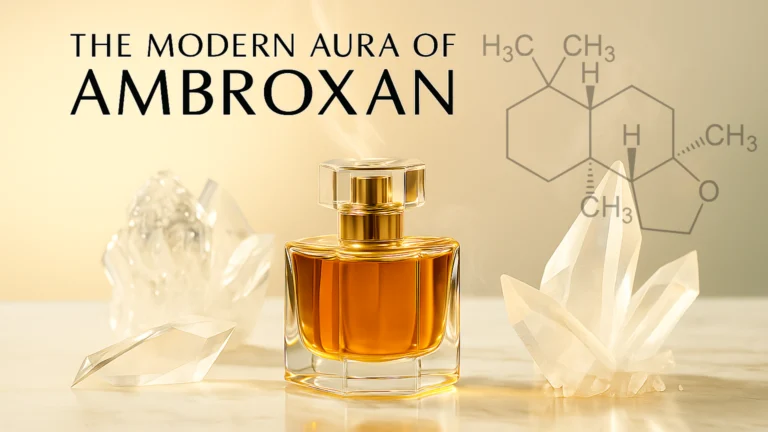 Education
What Is Ambroxan in Perfumery? A Complete Guide
Read more → Occasion
Best Office Fragrances for Women 2026: 5 Polished Picks
Read more → Education
Iso E Super in Perfumery: A Guide to the Ghost ingredient
Read more →
Scent Chronicles participates in affiliate programs. We may earn a commission on qualifying purchases made through links in this guide, at no additional cost to you. This never affects which fragrances we recommend or what we say about them. Read full policy →