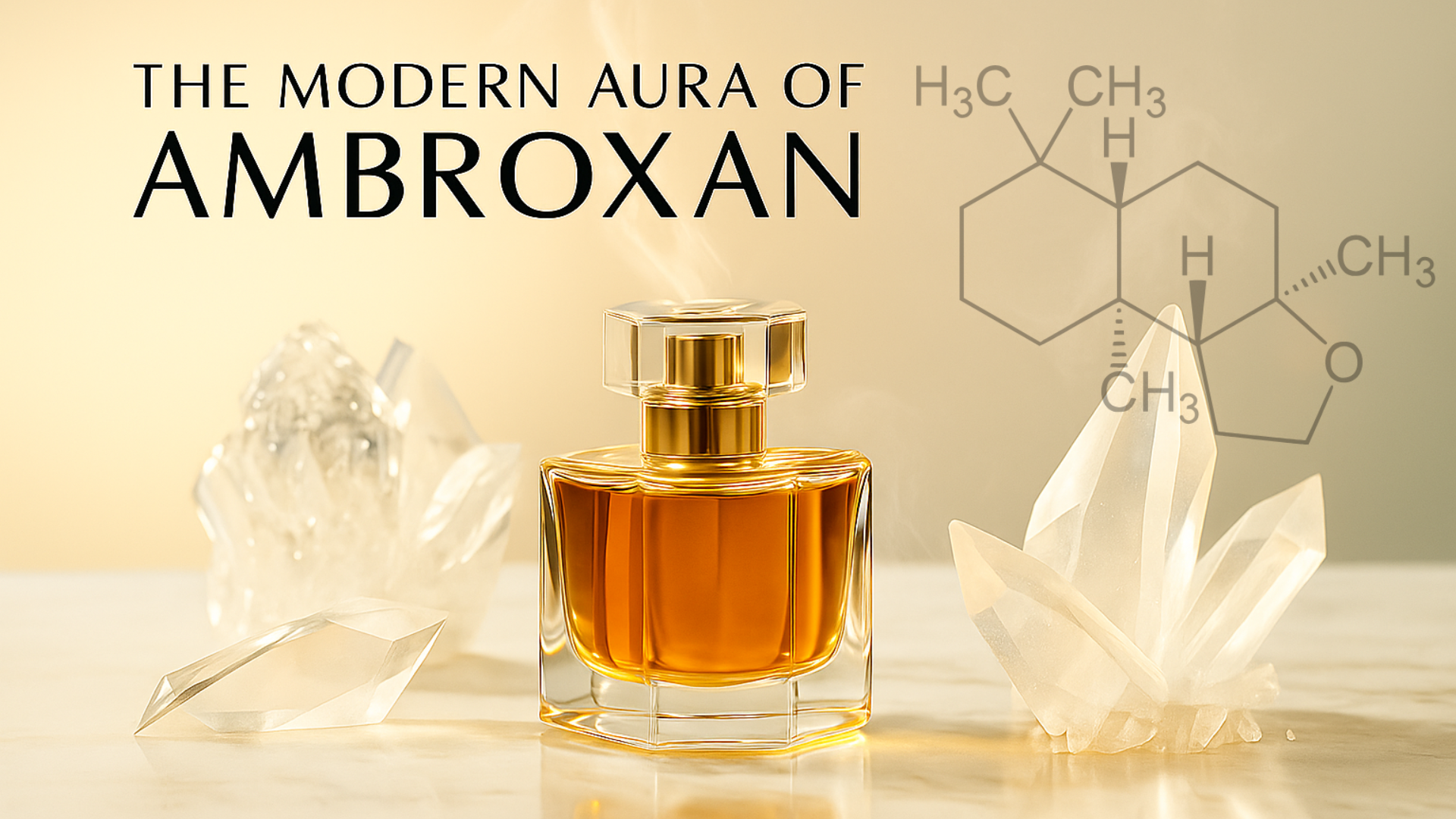
Ambroxan is the synthetic aroma chemical that has dominated mainstream designer perfumery since 2010. Originally developed as a synthetic substitute for natural ambergris (a rare and ethically-fraught marine material), ambroxan produces a salty, mineral-warm, slightly leathery character that has become the structural backbone of post-2015 designer compositions. Understanding ambroxan is understanding why so many modern designer fragrances smell warm and slightly amber-coded. They are all built on the same molecule, with different decorations layered on top.
Ambroxan is the synthetic backbone of post-2015 designer perfumery. If a fragrance smells warm-amber and modern, ambroxan is probably why.
- What it is: A synthetic aroma chemical (sclareolide derivative) that mimics natural ambergris.
- Where it lives: Sauvage EDT, Bleu de Chanel EDT, Y EDT, Luna Rossa Carbon, Khamrah, and 100+ more.
- Why it matters: Replaces natural ambergris ethically and economically. Provides warm-amber-mineral architecture.
What ambroxan actually is
Ambroxan is a single-isomer synthetic aroma chemical with the technical name (-)-(3aR,5aS,9aS,9bR)-3a,6,6,9a-tetramethyldodecahydronaphtho[2,1-b]furan. The shorthand name was coined by Henkel in the 1950s when the company first commercialised the molecule. Ambroxan is structurally derived from sclareolide, a natural compound found in clary sage, through a multi-step laboratory synthesis that produces a single isomer with consistently high aromatic purity.
The smell profile is best described as warm, mineral-amber, slightly salty, slightly leathery. Unlike most natural amber materials (labdanum, benzoin, vanilla), ambroxan does not project as a sweet-warm composition. Instead, it produces a “skin-like” salty mineral character that perfumers describe as radiant warmth. The molecule is a base-note fixative that anchors compositions for 8-24 hours of wear and amplifies surrounding notes without dominating them.
In commercial perfumery, ambroxan replaces natural ambergris in modern compositions. Ambergris, the digestive secretion of sperm whales, harvested from beaches where it washes ashore, was historically the most prized base-note fixative in luxury perfumery. Ambroxan is structurally similar to the dominant aromatic compound in ambergris (also called ambroxide), reproduces approximately 90% of the aromatic profile, and bypasses the ethical and economic problems of natural ambergris harvest. Today most designer-tier and niche-tier fragrances use ambroxan exclusively; only a handful of ultra-premium niche releases still use natural ambergris.
How ambroxan behaves on skin
On skin, ambroxan produces a warm-mineral character that develops slowly across the entire wear arc rather than blooming and fading like top or middle notes. The molecule binds with skin lipids and remains detectable for 12-24 hours of wear, which is why ambroxan-heavy compositions tend to “linger” longer than non-ambroxan equivalents. The salt-mineral character also produces a “skin-like” effect that wearers and observers describe as warmth or intimacy. The fragrance reads as if it has merged with the wearer rather than sitting on top of skin.
Skin chemistry affects ambroxan expression less dramatically than chemistry-sensitive notes like oud or iso e super, but still meaningfully. Buyers with drier skin tend to experience ambroxan as cleaner and more linear; buyers with oilier skin tend to experience the same compositions as warmer and more amplified. The molecule also responds to body temperature. Ambroxan-heavy compositions amplify in warm conditions (gym, hot weather) and project further than cooler-temperature wear would suggest.
In compositions where ambroxan plays a supporting role, you can usually identify it by behaviour rather than by direct smell. Ambroxan-heavy compositions extend longevity beyond their stated concentration, project warmth that increases over the first two hours rather than peaking immediately, and produce a “skin-like” quality that observers describe as natural rather than perfume-like. This last quality, the merger between fragrance and skin, is part of why ambroxan dominates compliment-magnet designer compositions in current production.
A short history of the molecule that rebuilt designer perfumery
Henkel commercialised ambroxan in the 1950s as a synthetic alternative to natural ambergris, primarily for industrial fragrance applications (soaps, detergents, household products) rather than for fine perfumery. Through the 1960s-90s, ambroxan was used at relatively modest concentrations in mainstream fragrances as one of several synthetic amber materials. The first major luxury showcase was Hermès Eau des Merveilles (2004), which used ambroxan at high concentration as a structural base-note around marine and orange-flower top notes.
The transformation came with three specific releases. Juliette Has A Gun Not A Perfume (2010) built an entire conceptual fragrance around the molecule, isolating it at near-pure concentration to demonstrate its perceptual character. Similar to how Escentric Molecules’ Molecule 01 had done for Iso E Super in 2006. Dior Sauvage EDT (2015) used ambroxan at unprecedented commercial concentrations as a structural element rather than a supporting note. Sauvage became one of the best-selling fragrances of the 2010s and dragged the entire mainstream designer market toward ambroxan-forward formulas.
YSL Y EDT (2017) and Y EDP (2018) consolidated ambroxan as the default modern men’s designer note, while YSL Libre (2019) and YSL Libre Le Parfum (2022) carried it into the modern feminine designer category. By 2025, ambroxan appeared in over 100 mainstream releases and serves as the structural backbone for the entire post-2015 designer perfumery category. Today, ambroxan and Iso E Super are the two synthetic molecules that account for the majority of mainstream designer composition by structural significance.
How to recognize ambroxan on skin
The fastest way to learn what ambroxan smells like is to wear Juliette Has A Gun Not A Perfume for a day. The composition is approximately 80% ambroxan and almost nothing else, designed specifically to showcase the molecule in isolation. Wear it once for a clean reference, then revisit any modern designer fragrance you already own. You will start hearing ambroxan underneath dozens of compositions you thought you already knew.
In compositions where ambroxan plays a supporting role, you can usually identify it by behavioral pattern. The fragrance reads warm-mineral rather than sweet-amber; longevity exceeds the listed concentration would predict; the dry-down has a “skin-like” quality that observers describe as natural rather than perfume-coded. If you have ever sniffed something on a partner’s skin hours after they applied it and thought “this just smells like them now”. There is a high probability ambroxan is the reason.
Some compositions wear the molecule openly. Sauvage EDT, Y EDT, Luna Rossa Carbon, Bleu de Chanel EDT, and Eau des Merveilles all use ambroxan at concentrations high enough that careful wearers can identify it. Others bury it more subtly. Most modern Tom Ford, Maison Francis Kurkdjian, and Initio compositions use ambroxan as a structural binder for their dominant character notes, but you have to know what to listen for in the dry-down phase.
Want to understand another defining synthetic?
If ambroxan is the salty mineral-warm backbone of modern designer perfumery, Iso E Super is its soft woody-amber counterpart. Equally dominant in mainstream releases since 2015, equally architecturally significant. The two molecules together account for the structural backbone of post-2015 designer perfumery. Read the Iso E Super guide →
Fragrances featuring ambroxan, ranked by how prominently it shows
Five well-known compositions where ambroxan plays a real structural role, ordered from most-prominent showcase to most-effective supporting role.
| Fragrance | Brand | Concentration | Role | Verdict |
|---|---|---|---|---|
Not A Perfume View on Amazon → | Juliette Has A Gun | ~80% | Pure showcase | The reference. Wear once for the cleanest possible read on the molecule itself. |
Sauvage EDT View on Amazon → | Dior | Heavy | Designer backbone | The 2015 release that made ambroxan the default mainstream designer note. |
Y EDT View on Amazon → | YSL | Heavy | Modern men's anchor | Ambroxan-bergamot-pepper structure. The modern men's daily-driver template. |
Luna Rossa Carbon View on Amazon → | Prada | Significant | Structural anchor | Lavender-mineral-ambroxan. The most year-round capable post-2015 designer. |
Bleu de Chanel EDT View on Amazon → | Chanel | Significant | Architectural binder | Citrus-cedar-ambroxan. The polished men's designer reference. |
“Ambroxan is the synthetic backbone of post-2015 designer perfumery. If a fragrance smells warm-amber and modern, ambroxan is probably why.
Rodrigo H. · Counter Notes
Ambroxan is the most quietly important synthetic aroma chemical in modern designer perfumery. If you understand ambroxan and Iso E Super, you understand the structural shape of post-2015 designer composition. They are the two molecules that define what “modern designer” smells like.
For buyers curious enough to want a reference for what ambroxan actually smells like in isolation, Juliette Has A Gun Not A Perfume is the only commercially-available bottle that gives that experience cleanly. Everything else uses ambroxan as a supporting structural element. The educational value of wearing Not A Perfume for a week, then revisiting fragrances you already own, is genuinely high. You start hearing the same molecule underneath dozens of compositions you thought you already knew.
Common questions
+What does ambroxan smell like?
Warm, salty, mineral, slightly leathery, slightly amber. Unlike traditional amber materials (labdanum, benzoin, vanilla), ambroxan does not read sweet or candy-coded. The cleanest reference is to wear Juliette Has A Gun Not A Perfume, which is approximately 80% ambroxan in isolation.
+Why is ambroxan in so many fragrances?
Three reasons. First, it produces a “skin-like” warm-mineral effect that consumers respond to in blind testing. Second, it extends longevity dramatically without competing for character with other notes. Third, it bypasses the ethical and economic problems of natural ambergris while reproducing approximately 90% of the natural material’s aromatic profile. The result: ambroxan has quietly become the default base-note fixative in post-2015 designer perfumery.
+Is ambroxan the same thing as ambergris?
Closely related but not identical. Natural ambergris contains over 30 aromatic compounds; ambroxan replicates the dominant compound (ambroxide). Ambroxan reproduces approximately 90% of natural ambergris’s aromatic profile but lacks some of the more subtle marine-mineral character of the natural material. For practical perfumery purposes, ambroxan is the modern industry-standard substitute for ambergris; only a handful of ultra-premium niche releases still use natural ambergris.
+Is natural ambergris ethical?
Mostly yes, with caveats. Ambergris is naturally excreted by sperm whales and washes ashore as sun-bleached, salt-cured material that perfumers can collect ethically. However, sperm whales are an endangered species, and historical demand for ambergris contributed to whaling industry overexploitation. The synthetic alternative (ambroxan) bypasses this ethical concern entirely; modern ambergris harvest is generally limited to beach-found material rather than active whale-hunting.
+How does ambroxan compare to Iso E Super?
Both are synthetic structural molecules that dominate post-2015 designer perfumery. Ambroxan produces a warmer, more mineral-amber character; Iso E Super produces a softer, more woody-amber character. Most modern designer compositions use both molecules together. Ambroxan as the warmth-fixative anchor and Iso E Super as the radiant amplifier. Together they account for the structural backbone of post-2015 designer perfumery.
+Can I be anosmic to ambroxan?
Yes, though less commonly than for Iso E Super. Roughly 5-10% of people experience reduced sensitivity to ambroxan compared to baseline population perception, which means the same composition can read distinctly different on different wearers. The good news: this anosmia is partial rather than complete. Most affected wearers can still appreciate ambroxan-heavy compositions, just at lower projection than baseline.
 Education
What Are Fragrance Families? A Simple Guide for Beginners
Read more → Education
What is Sillage in Perfumery? Definition and Meaning
Read more → Education
Iso E Super in Perfumery: A Guide to the Ghost ingredient
Read more → Education
What Is Iris in Perfumery? Smell, History, and Best Perfumes
Read more →
Scent Chronicles participates in affiliate programs. We may earn a commission on qualifying purchases made through links in this guide, at no additional cost to you. This never affects which fragrances we recommend or what we say about them. Read full policy →