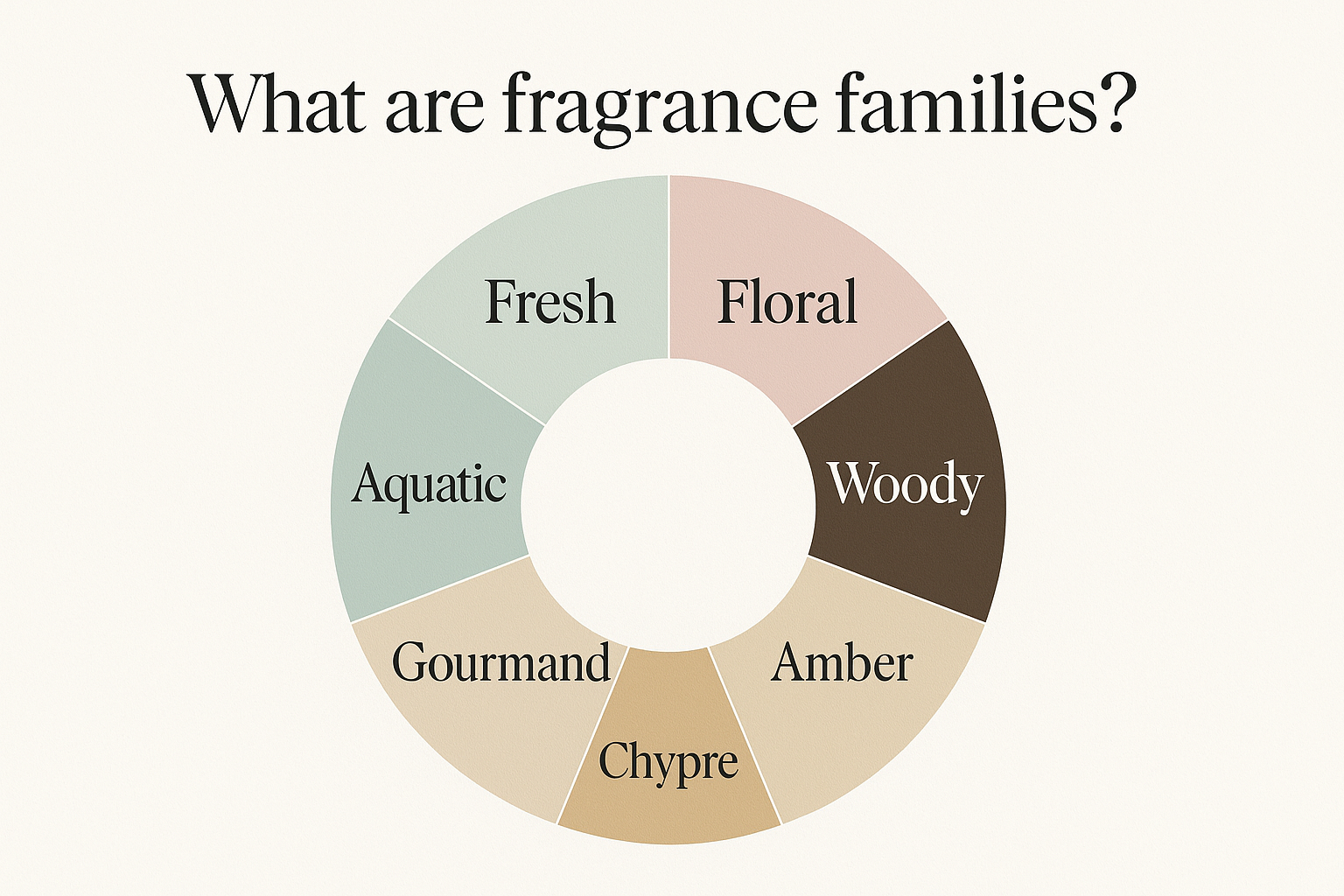
Fragrance families are the genre system that organises every composition into recognisable categories. Woody, oriental, floral, fougère, chypre, gourmand, fresh-aquatic, leather. Understanding the families makes shopping dramatically easier because most buyers respond strongly to one or two families and weakly to the others. Instead of evaluating individual bottles in isolation, you can shop within your dominant family or families and skip the categories that have never worked for you.
Fragrance families are the genre system. Most buyers respond to one or two families and skip the rest.
- Major families: Woody, Oriental, Floral, Fougère, Chypre, Gourmand, Fresh-Aquatic, Leather.
- Why they matter: Most buyers respond to one or two families and weakly to others.
- How to use them: Identify your family, shop within it, skip the categories that have never worked.
What fragrance families are
Fragrance families are the categorical system that organises perfumery compositions into recognisable genres based on dominant aromatic character. The system has been in use since the 19th century, with the modern eight-family categorisation formalised by the French Society of Perfumers (Société Française des Parfumeurs) in the late 20th century.
The eight major families are: Woody (cedar, sandalwood, vetiver), Oriental (amber, vanilla, balsam, exotic spices), Floral (single or composite floral materials), Fougère (lavender, oakmoss, coumarin. The classical masculine architecture), Chypre (oakmoss, bergamot, labdanum. The classical feminine architecture), Gourmand (vanilla, caramel, chocolate, food-coded notes), Fresh-Aquatic (citrus, aquatic, marine, light aromatic), and Leather (smoky-tannic, suede, saddle profiles).
In commercial practice, most modern compositions blend elements from multiple families rather than fitting cleanly into a single category. Sauvage Elixir sits between Oriental and Spicy; Bleu de Chanel sits between Woody-Aromatic and Fresh-Aquatic; Cloud sits between Gourmand and Floral. The family classification is most useful as a starting framework rather than as a strict taxonomy. Modern compositions reward more nuanced classification than the traditional eight-family system suggests.
How families develop on skin
Different fragrance families develop along different timeline arcs. Fresh-Aquatic compositions front-load top-note projection (citrus, aquatic, light florals) that lasts 3-6 hours total; the dry-down phase is short and clean. Woody and Oriental compositions develop more gradually, with the architectural anchor revealing across the middle phase (2-6 hours) and holding through 8-12 hour dry-downs. Floral compositions typically have moderate projection across all phases, with the dominant flower revealing fully by hour 2 and softening across hours 4-8.
Gourmand compositions front-load sweetness in the opening hours and gradually evolve toward warmer base notes. Fougère compositions follow a classical aromatic-to-mossy arc that rewards 6-10 hour wear evaluation. Chypre compositions develop most architecturally, with the oakmoss-citrus-labdanum structure revealing complexity across the entire wear arc. Leather compositions vary by leather type. Smoky-tannic profiles project polarisingly in opening, while saddle-clean profiles project more evenly throughout wear.
Skin chemistry affects family expression differently. Fresh-Aquatic and Floral families are relatively chemistry-stable; Oriental, Gourmand, and Leather families show more dramatic wearer-to-wearer variation. Buyers exploring families they have not previously worn should sample for at least one full week of wear to evaluate Phase 2 integration sustainability. First-impression family responses can mislead about long-term wearability.
A short history of the family system
The fragrance family system descends from 19th-century European perfumery classification practices, where perfumers and retailers organised inventory by dominant aromatic character. The modern eight-family system was formalised by the Société Française des Parfumeurs in the 1970s-80s, drawing on earlier work by Edmond Roudnitska and other 20th-century perfumers.
Through the 20th century, the family system primarily served retail and educational purposes. Helping buyers navigate inventory and helping perfumery educators teach categorisation. The post-2000 era has seen the system both extended (more granular sub-categories like Woody-Aromatic, Oriental-Vanilla, Floral-Fruity) and challenged (modern compositions blend across families in ways that resist clean classification).
Today, the family system remains useful for buyer-facing categorisation but less useful for strict perfumery analysis. Most modern compositions blend across multiple families, and detailed reviewing communities (Fragrantica, Reddit) commonly use 15-20 sub-category tags rather than the traditional eight families. For first-time fragrance buyers, the eight-family system provides a useful starting framework; for sophisticated buyers, more granular sub-categorisation produces more accurate evaluation.
The eight major fragrance families
Woody: Cedar, sandalwood, vetiver, oud, agarwood. Examples: Bleu de Chanel EDP, Tom Ford Oud Wood, Hermès Terre d’Hermès. The classical masculine architectural family; reads polished and grown-up. Year-round capability with strong cold-weather emphasis.
Oriental: Amber, vanilla, benzoin, exotic spices. Examples: Tom Ford Tobacco Vanille, Sauvage Elixir, Khamrah. Originally coded “exotic” in 19th-century European perfumery vocabulary; now describes warm-amber-vanilla compositions across genders. Strong cold-weather and evening capability.
Floral: Rose, jasmine, tuberose, gardenia, peony. Examples: Coco Mademoiselle EDP, Diptyque Eau Rose, YSL Libre. The classical feminine architectural family; ranges from light and bright to heavy and indolic. Year-round capability with strong spring-summer emphasis for lighter florals.
Fougère: Lavender, oakmoss, coumarin, geranium. Examples: Drakkar Noir, Paco Rabanne 1 Million, Aramis. The classical masculine fern-coded architecture; produces clean-grown-up signatures. Year-round capability.
Chypre: Oakmoss, bergamot, labdanum, patchouli. Examples: Mitsouko, Chanel No. 19, Aromatics Elixir. The classical feminine green-aromatic architecture; reads sophisticated and architectural. Year-round capability with strong fall emphasis.
Gourmand: Vanilla, caramel, chocolate, coffee, cotton candy, marshmallow. Examples: Angel, Cloud, Sweet Tooth, La Vie Est Belle. The food-coded category; emerged in the 1990s and now dominates feminine perfumery. Strong cold-weather emphasis.
Fresh-Aquatic: Citrus, aquatic, marine, light aromatic. Examples: Acqua di Giò Profumo, Aqua Universalis Forte, Light Blue. The cleanest and most warm-weather-appropriate family; reads bright and active. Spring-summer emphasis.
Leather: Smoky-tannic, suede, saddle profiles. Examples: Tom Ford Ombré Leather, Knize Ten, Bottega Veneta. The most architecturally distinctive family; reads grown-up and evening-coded. Strong fall-winter and evening emphasis.
Want to find your signature scent?
Once you identify the fragrance family you respond to, the next step is finding specific bottles that match your architectural preferences. The signature-scent guide covers the methodical five-step framework for committing to compositions you wear for years. Read the signature scent guide →
“Fragrance families are the genre system. Most buyers respond to one or two families and skip the rest.
Rodrigo H. · Counter Notes
The fragrance family system is one of the most useful frameworks for first-time fragrance buyers and one of the most useful frameworks for established buyers building structured rotations. Identifying which families you respond to dramatically narrows the universe of bottles to evaluate, and saves both time and budget compared to evaluating individual bottles in isolation.
For first-time buyers, start by sampling across all eight families to identify your two strongest responses. Most buyers respond strongly to two families and weakly to the others; you can build entire rotations within those two families and skip the others entirely. The right shopping discipline is family-first, then bottle-second.
Common questions
+How many fragrance families are there?
Eight major families: Woody, Oriental, Floral, Fougère, Chypre, Gourmand, Fresh-Aquatic, and Leather. The eight-family system is the standard categorisation used by major fragrance retailers, educational institutions, and reviewing communities. More granular sub-classification systems exist (15-20 categories) but the eight-family framework is the right starting point for most buyers.
+Are fragrance families gender-coded?
Some, historically. Fougère traditionally coded masculine; Chypre traditionally coded feminine. Modern perfumery has largely eroded these gender associations. Fougère compositions read appropriately on women, Chypre compositions read appropriately on men, and most modern compositions are explicitly unisex. Family classification today is primarily about architectural character rather than gender coding.
+Can a fragrance belong to multiple families?
Yes. Most modern compositions blend across families. Sauvage Elixir is Oriental-Spicy; Bleu de Chanel is Woody-Aromatic-Fresh; Cloud is Floral-Gourmand. The eight-family system is most useful as a starting framework rather than as a strict taxonomy. For nuanced classification, sub-category tags (Oriental-Vanilla, Floral-Fruity, Woody-Aromatic) produce more accurate evaluation.
+Which fragrance family is most popular?
For men, Woody and Oriental dominate (Bleu de Chanel, Sauvage, Layton, Tobacco Vanille all sit in these families). For women, Floral and Gourmand dominate (Coco Mademoiselle, Cloud, Libre Le Parfum, Sweet Tooth). The most popular family combination across both genders is Oriental-Gourmand (warm-amber-vanilla compositions like Khamrah, Sauvage Elixir, Baccarat Rouge 540).
+What family is right for me?
Sample across all eight families and identify which two produce the strongest positive response. Most buyers respond strongly to two families. Office contexts favour Woody, Fresh-Aquatic, and lighter Florals. Evening contexts favour Oriental, Leather, and heavier Florals. Cold-weather contexts favour Oriental, Gourmand, and Leather. Warm-weather contexts favour Fresh-Aquatic, Fougère, and lighter Florals.
+How do I shop within a family?
Once you identify your dominant family, sample 5-10 bottles within that family at different price tiers (designer-tier, niche-tier, budget-tier). The architectural variety within a single family is significant. Within Oriental, you can find compositions ranging from Tobacco Vanille to Khamrah to Baccarat Rouge 540 to Initio Oud for Greatness, each with distinctive character. Family identification narrows the search; bottle-specific evaluation determines the final commitment.
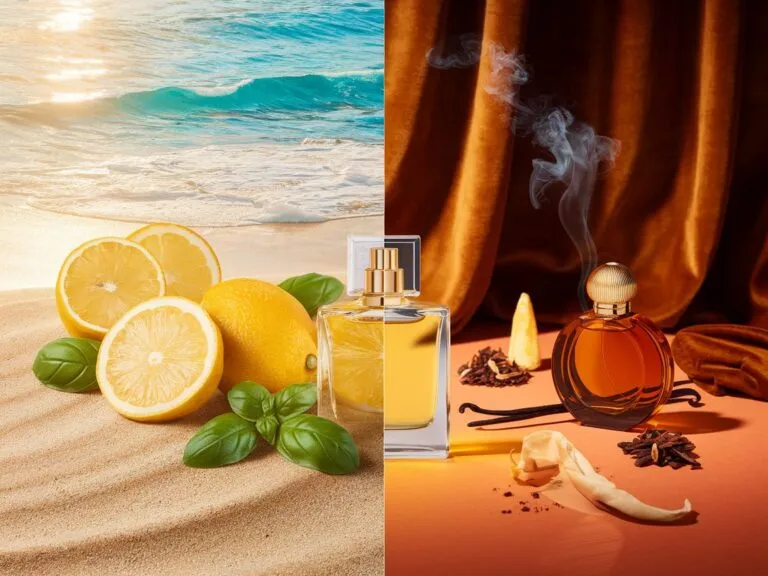
How To Know Which Season A Fragrance Is Designed For
Read more → Education
What is Sillage in Perfumery? Definition and Meaning
Read more → Education
Perfume Layering: The Complete Guide
Read more → Education
Leather in perfumery: suede vs smoky and how to wear it
Read more → Education
Iso E Super in Perfumery: A Guide to the Ghost ingredient
Read more →
Scent Chronicles participates in affiliate programs. We may earn a commission on qualifying purchases made through links in this guide, at no additional cost to you. This never affects which fragrances we recommend or what we say about them. Read full policy →