Iso E Super is the most-used synthetic molecule you have probably never heard named, yet you have almost certainly smelled it. It is the structural backbone of Dior Sauvage, the entire raison d’être of Escentric Molecules’ Molecule 01, the soft woody-amber haze that lingers around Terre d’Hermès, and a quiet contributor to over a hundred mainstream releases since 1973. Understanding Iso E Super is understanding the modern shape of fragrance, why so many bottles smell warm and slightly velvety in a way perfumes from the 1960s never did.
Iso E Super does not smell loud. It smells like memory, like the skin of someone you want to come back to. Which is why fragrance houses cannot stop using it.
- What it is: A single-isomer synthetic woody-amber molecule patented by IFF chemist John Hall in 1973.
- Where it lives: Sauvage, Molecule 01, Fierce, Halston Z-14, Terre d’Hermès, Bleu de Chanel, and 100+ more.
- What it does: Soft, transparent, slightly velvety. Amplifies surrounding notes and creates a warm aura on skin.
What Iso E Super actually is
Iso E Super is a single-isomer synthetic aroma chemical, technically known as (±)-1-(1,2,3,4,5,6,7,8-octahydro-2,3,8,8-tetramethyl-2-naphthalenyl)ethanone in IUPAC nomenclature. The shorthand the industry actually uses, Iso E Super, was coined by International Flavors & Fragrances (IFF) when they patented the molecule in 1973. The chemist behind it was John B. Hall, working in the IFF labs in Union Beach, New Jersey.
The smell profile is best described as a soft, transparent, woody-amber. Unlike traditional natural woody materials (sandalwood, cedar, vetiver), Iso E Super does not project loudly or announce itself. It sits close to skin and produces a warm, slightly velvety aura that perfumers describe as radiant, a technical term meaning the molecule extends the perceived presence of other notes around it without dominating them itself.
After the original IFF patent expired in the early 2000s, Iso E Super became one of the most commercially manufactured synthetic aroma chemicals in the world. Today most major fragrance houses produce their own version, IFF still makes the original, while Givaudan, Symrise, and Firmenich each produce structurally similar molecules under different trade names (Iso Super Gamma, Galaxolide variants, etc.). The single isomer that produces the cleanest, most “luxurious” effect remains the IFF original.
How it behaves on skin
On skin, Iso E Super behaves unlike almost any other note in the modern perfumer’s palette. It does not have a strong personality of its own, instead, it acts as an amplifier for whatever else is in the composition. This is why it appears in so many mainstream releases: a perfumer can use it to extend the longevity, projection, and “skin-warmth” of a fragrance without competing with the brief or accord they were actually asked to deliver.
The note becomes more noticeable in two scenarios. First, when used at high concentrations, most famously in Escentric Molecules’ Molecule 01, which is approximately 65% Iso E Super and almost nothing else, designed specifically to showcase what the molecule smells like in isolation. Second, on certain skin chemistries, Iso E Super interacts strongly with skin sebum, and some wearers report it “blooming” hours into wear in a way that becomes almost the dominant note. Other wearers report being mildly anosmic to certain isomers, which is a documented neurological response that affects roughly 20% of people for at least one of the major isomers.
In daily wear, the practical effect is that fragrances heavy in Iso E Super, Sauvage, Fierce, Molecule 01, perform better than their concentration would suggest. They project softly but for longer than expected, and skin chemistry plays an outsized role in how they actually smell on each wearer. This is partly why these fragrances are so polarising: someone whose skin amplifies the molecule will smell something different than someone whose skin masks it.
A short history of the molecule that changed perfumery
The first major commercial use of Iso E Super was in Halston Z-14 (1976), where perfumer Vince Marcello used it as a soft woody backbone for a chypre composition. Three years later Polo by Ralph Lauren (1978) and then Polo Crest (1991) followed, and through the 1980s and 90s the molecule became a quiet standard ingredient in masculine fragrance.
The transformation came with two specific releases that pushed Iso E Super from supporting role into category-defining structural note. The first was Escentric Molecules’ Molecule 01 (2006), the perfumer Geza Schoen built an entire conceptual fragrance around it, isolating the molecule at near-pure concentration to demonstrate that synthetic aroma chemicals could be aesthetically interesting on their own, not just functional. The second was Dior Sauvage EDT (2015), which used Iso E Super at unprecedented commercial concentrations as a structural element rather than a supporting note. Sauvage became one of the best-selling fragrances of the 2010s, and dragged the entire mainstream designer market toward the same Iso E Super-forward formula.
Today, Iso E Super appears in over 100 mainstream releases, from Tom Ford and Maison Francis Kurkdjian at the niche tier, to Bleu de Chanel and Allure Homme at the luxury designer tier, to the entire Lattafa and Afnan Middle Eastern designer-clone catalog. It has quietly become the most-used synthetic aroma chemical in modern perfumery, and the reason so many fragrances released in the past decade smell familiar in a way you cannot quite name.
How to recognize Iso E Super on skin
The easiest way to learn what Iso E Super smells like is to wear Molecule 01 for a day. At 65% concentration of nearly the only note in the bottle, it gives you a clean reference for the molecule on its own, a soft, slightly cocoa-coated woody-amber haze that sits 6-8 inches off skin. That is what a perfumer means when they say “Iso E Super.” Once you have it as a reference, you start hearing it underneath dozens of other compositions you already own.
In compositions where it plays a supporting role, you can usually identify Iso E Super by a specific behavioral pattern: the fragrance smells warmer and softer in the dry-down than the listed notes would predict, projects close rather than loudly, and has a “skin-like” quality that bloom-amplifies six to eight hours into wear. If you have ever sniffed something on your wrist hours after applying it and thought “this smells better now than when I sprayed it”, there is a high probability Iso E Super is the reason.
Some compositions wear the molecule openly. Sauvage, Fierce, Halston Z-14, Polo Crest, Bleu de Chanel L’Exclusif, and Terre d’Hermès all use Iso E Super at concentrations high enough that careful wearers can identify it. Others bury it more subtly, Tom Ford’s Tobacco Vanille and Oud Wood both use it as a modern wood replacement for the natural oud they cannot legally include at scale, but you have to know what to listen for.
Want to understand another modern aroma chemical?
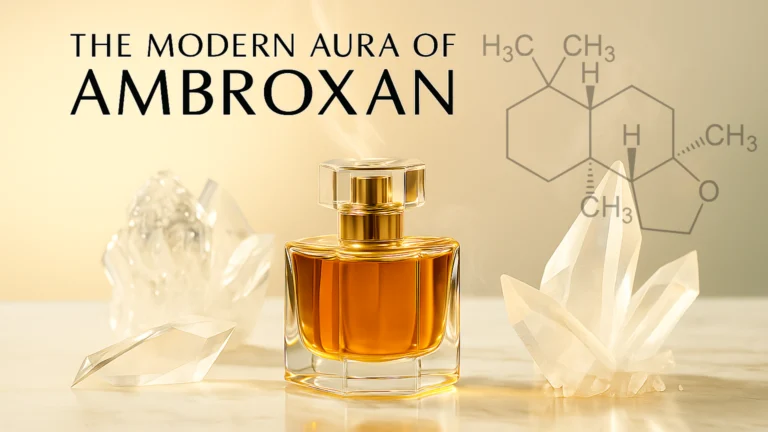
If Iso E Super is the soft woody-amber haze of modern fragrance, Ambroxan is its salty, mineral-warm cousin, equally dominant in mainstream designer releases since 2010. The two molecules together account for the entire structural backbone of post-2015 designer perfumery. Read the Ambroxan guide →
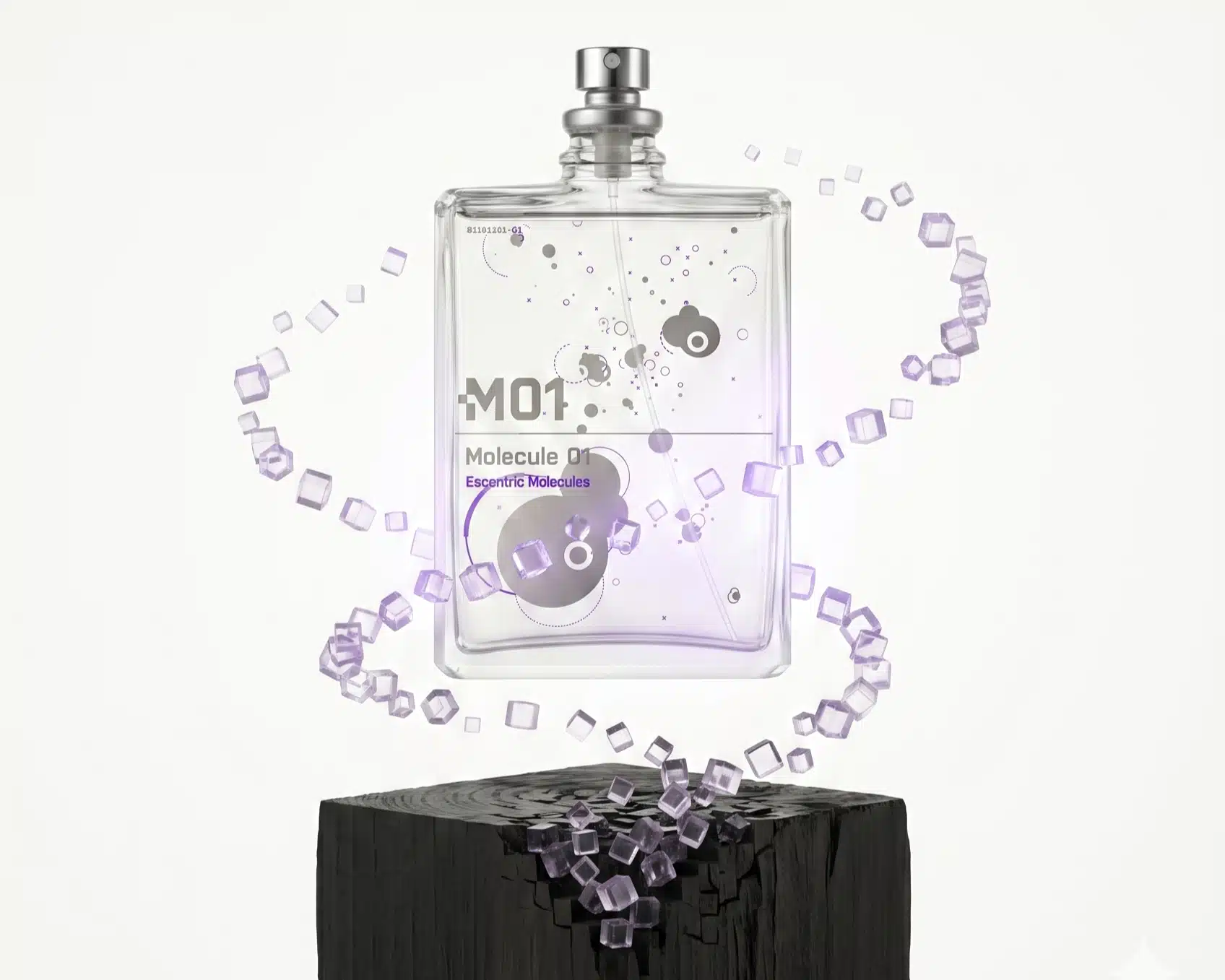
Molecule 01
Escentric Molecules · EDT · 200ml
Geza Schoen built this 2006 release around Iso E Super at near-pure concentration as a conceptual showcase of what the molecule smells like in isolation. Wear it once for a clean reference, then revisit any fragrance you already own, you will start hearing the same molecule underneath compositions you thought you already knew.
Fragrances featuring Iso E Super, ranked by how prominently it shows
Five well-known compositions where Iso E Super is doing real structural work, ordered from most-prominent showcase to most-effective supporting role. Each one is worth smelling if you want to develop an ear for the molecule.
| Fragrance | Brand | Concentration | Role | Verdict |
|---|---|---|---|---|
Molecule 01 View on Amazon → | Escentric Molecules | ~65% | Pure showcase | The reference. Wear once for the cleanest possible read on the molecule itself. |
Sauvage EDT View on Amazon → | Dior | Heavy | Structural backbone | The 2015 release that made Iso E Super the default mainstream designer note. |
Fierce View on Amazon → | Abercrombie & Fitch | Heavy | Signature aura | Iconic 2002 fougère; the entire bloom on dry-down is Iso E Super. |
Halston Z-14 View on Amazon → | Halston | Significant | Foundation (1976) | The first major commercial use of the molecule. Still wearable in 2026. |
Terre d'Hermès View on Amazon → | Hermès | Significant | Modern wood backbone | Jean-Claude Ellena uses it as the structural spine for the entire dry-earth composition. |
“Iso E Super does not smell loud. It smells like memory, like the skin of someone you want to come back to. Which is why fragrance houses cannot stop using it.
Rodrigo H. · Counter Notes
Iso E Super is the most quietly important aroma chemical in modern perfumery. If you understand it, you understand why so many post-2010 designer fragrances feel familiar on first sniff, they are all built on the same structural molecule, with different decorations layered on top.
If you are curious enough to want a reference for what the molecule actually smells like in isolation, Molecule 01 is the only bottle that gives you that experience cleanly. Everything else uses it as a supporting note. The educational value of wearing Molecule 01 for a week, then revisiting fragrances you already own, is genuinely high, you start hearing the same molecule underneath compositions you thought you already knew.
Common questions
+What does Iso E Super smell like?
A soft, transparent, woody-amber. Slightly velvety, slightly cocoa-coated, never loud. The cleanest reference is to wear Molecule 01 from Escentric Molecules, it is approximately 65% Iso E Super and almost nothing else. Once you know the smell in isolation, you start hearing it underneath dozens of mainstream fragrances.
+Why is Iso E Super in so many fragrances?
Three reasons. First, the patent expired in the early 2000s, so anyone can use it without licensing fees. Second, it amplifies other notes in a composition without competing for attention, perfumers can extend longevity and projection without changing the brief. Third, it produces a warm, “skin-like” effect that mainstream consumers respond to in blind testing. The result: it has quietly become the default structural note in post-2015 designer perfumery.
+Can I be anosmic to Iso E Super?
Yes, this is documented. Roughly 20% of people are anosmic (smell-blind) to at least one of the major Iso E Super isomers. If you have ever tried Molecule 01 and thought “I cannot smell anything” while everyone around you commented on it, that is probably why. The good news: this anosmia is selective, most people who cannot smell one isomer can still smell others, so they can still appreciate fragrances using the molecule.
+Is Iso E Super the same thing as Iso Super?
Closely related but not identical. Iso E Super refers specifically to the IFF-original molecule with a particular isomer ratio. After the patent expired, other manufacturers (Givaudan, Symrise, Firmenich) produced structurally similar molecules under names like Iso Super Gamma, Galaxolide variants, and proprietary trade names. Most modern fragrances use a mix of these, true Iso E Super is more expensive and tends to appear in higher-tier compositions.
+Is Molecule 01 worth buying just to smell Iso E Super?
For anyone who wears fragrance with intention, yes. Molecule 01 is the only bottle that gives you a clean reference for what Iso E Super smells like on its own, which permanently changes how you experience every other fragrance you own. It is also a perfectly wearable scent in its own right, soft, modern, polarising in the best way. The 200ml bottle costs around $200 and lasts most wearers two to three years.
+Why does Iso E Super smell different on different people?
Iso E Super interacts strongly with skin sebum, the body’s natural oil. Sebum composition varies significantly person to person, driven by hormones, diet, age, and skin pH. The molecule “blooms” differently as it reacts with these oils, which is why two people wearing Molecule 01 can smell almost completely different fragrances four hours into wear. This is also part of why fragrances heavy in the molecule (Sauvage, Fierce) are so divisive, wearer reactions vary more than for traditional natural-material compositions.


Scent Chronicles participates in affiliate programs. We may earn a commission on qualifying purchases made through links in this guide, at no additional cost to you. This never affects which fragrances we recommend or what we say about them. Read full policy →