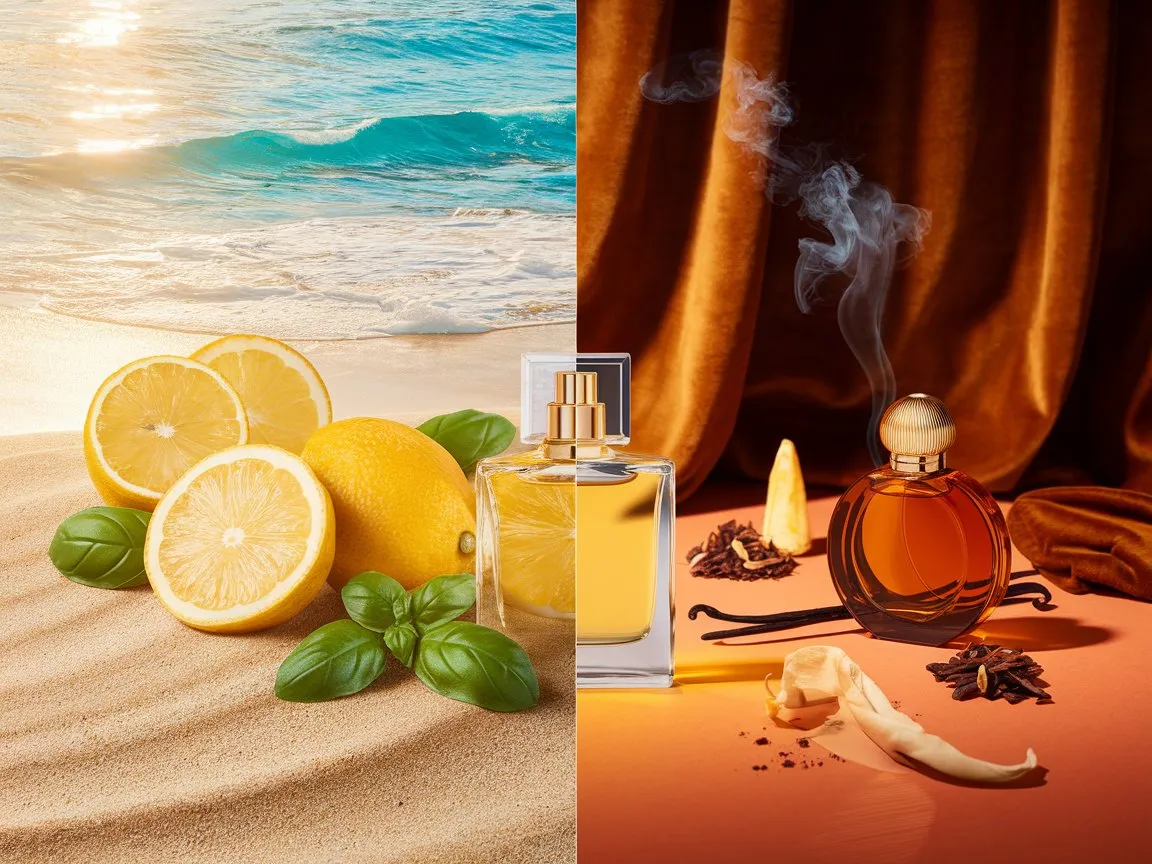
Fragrance and season are linked through chemistry. Cold air slows volatile aromatic compounds, while warm air accelerates them. Compositions that read appropriate in winter can read overpowering in summer; compositions that read bright in summer can read thin in winter. Understanding the seasonal capability of each composition family is essential for building a rotation that performs across all twelve months rather than one optimised for a single season.
Cold air amplifies heavy compositions; warm air amplifies light ones. The right rotation has bottles for each end of the spectrum.
- Cold weather: Heavy compositions: Oriental, Gourmand, Leather, Tobacco-Vanilla.
- Warm weather: Light compositions: Fresh-Aquatic, light Floral, Citrus, Fougère.
- Year-round: Mid-projection compositions: Woody-Aromatic, Polished Designer, Layton-style.
Why season matters in fragrance
Fragrance and season are linked through the chemistry of aromatic compound evaporation. Aromatic molecules release from skin into the surrounding air at rates determined by molecular weight and ambient temperature. Cold air slows the evaporation rate; warm air accelerates it. The same composition projects and develops differently across temperature ranges. A fragrance that reads balanced at 20°C can read thin at 5°C or overpowering at 30°C.
Compositions are typically engineered with a target temperature range in mind. Cold-weather compositions (Tom Ford Tobacco Vanille, Khamrah, Initio Oud for Greatness) use heavier base-note materials that bloom slowly in cold air and produce architecturally satisfying development arcs at temperatures below 15°C. Warm-weather compositions (Acqua di Giò Profumo, Aqua Universalis Forte, Light Blue) use lighter top-note structures that project appropriately at temperatures above 20°C without overwhelming the wearer.
In commercial practice, most modern designer compositions are engineered for year-round wearability across moderate temperate climate ranges (10-25°C). Niche-tier compositions are more frequently optimised for specific seasonal contexts. The right rotation strategy depends on climate. Buyers in temperate climates can build smaller rotations of year-round-capable compositions; buyers in extreme climates (very hot, very cold, dramatic seasonal swings) need larger rotations with explicit seasonal specialisation.
How temperature affects projection
Cold air slows aromatic compound evaporation by 20-50% compared to warm air, which means cold-weather wear typically extends overall fragrance longevity but reduces opening-hour projection. Compositions heavy in base-note materials (oud, vanilla, amber, musks) bloom most architecturally in cold conditions because the slow evaporation lets the base structure reveal gradually rather than being overwhelmed by faster-evaporating top notes.
Warm air accelerates evaporation by 20-100% compared to cold air, which means warm-weather wear typically reduces overall longevity but amplifies opening-hour projection. Compositions emphasising top-note materials (citrus, light florals, aquatic notes) project most effectively in warm conditions because the fast evaporation produces sharp, bright opening impressions rather than diluted projection.
Body temperature also affects projection independently of ambient temperature. Active wearers (gym, exercise, physical labour) experience amplified projection from any composition because warmer skin accelerates aromatic compound release. Sedentary wearers experience reduced projection from the same compositions. The right composition for active warm-weather contexts (Acqua di Giò Profumo for summer outdoor work) differs from the right composition for sedentary warm-weather contexts (Bergamote 22 for indoor air-conditioned offices).
A short history of seasonal perfumery
Seasonal fragrance practice descends from European 18th-19th-century perfumery, where wealthy wearers commonly maintained “winter” and “summer” perfume sets. Denser amber-floral compositions for cold weather, lighter citrus-floral compositions for warm weather. The seasonal practice was driven partly by chemistry (cold-weather wear of heavy compositions, warm-weather wear of light compositions) and partly by social convention (different fragrance categories for different seasonal contexts).
The 20th-century mass-market perfumery industry largely abandoned explicit seasonal specialisation in favour of “year-round” compositions optimised for moderate temperate climates. Through the 1970s-2000s, most mainstream designer releases positioned as universally wearable across seasons, and the seasonal-rotation practice became less common among general consumer buyers.
The post-2010 niche perfumery revival has reintroduced seasonal specialisation as a sophisticated buying practice. Modern niche houses (Maison Francis Kurkdjian, Hermès, Le Labo, Diptyque) actively recommend seasonal rotation, and reviewing communities widely discuss seasonal capability as a standard part of composition evaluation. Today, sophisticated fragrance buyers commonly maintain 3-5 bottle rotations explicitly structured around seasonal contexts.
How to match season to composition
Cold weather (below 15°C, fall-winter): Choose heavier compositions with strong base-note anchors. Oriental, Gourmand, Leather, Tobacco-Vanilla, and Heavy-Floral families all perform best in cold conditions. Specific examples: Tom Ford Tobacco Vanille, Khamrah, Sauvage Elixir, Initio Oud for Greatness, Baccarat Rouge 540. The cold air slows the volatile compounds and lets the architectural base reveal gradually across 8-12 hour wear arcs.
Warm weather (above 22°C, late spring-summer): Choose lighter compositions with strong top-note structures. Fresh-Aquatic, Citrus, light Floral, and Fougère families all perform best in warm conditions. Specific examples: Acqua di Giò Profumo, Aqua Universalis Forte, Bergamote 22, Light Blue, Sauvage EDT. The warm air accelerates the aromatic compounds and produces bright opening projection without overwhelming the wearer.
Transitional weather (15-22°C, spring and fall): Choose mid-projection compositions or year-round-capable bottles. Polished Designer (Bleu de Chanel EDP, Y EDP), Apple-Vanilla (Layton), and architectural Niche (Aqua Universalis Forte upgraded to EDP, Eau Rose) all bridge transitional weather effectively. The mid-temperature range tolerates a wider compositional spectrum than either extreme.
Want to understand fragrance families?
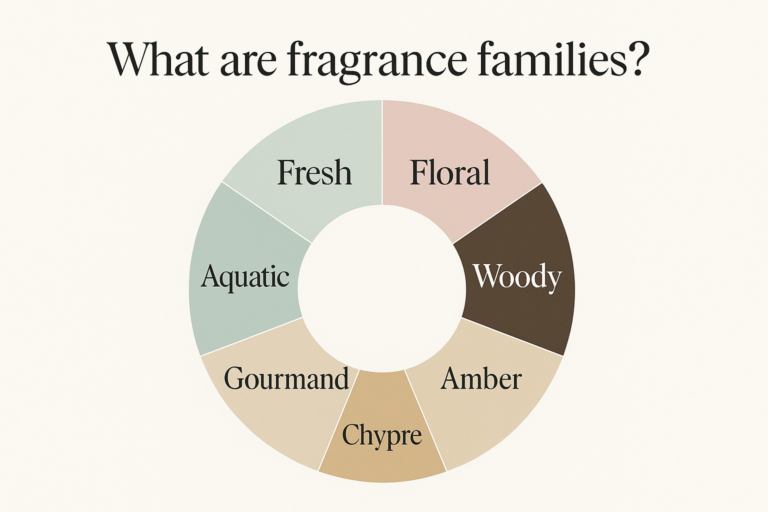
Seasonal capability is closely tied to fragrance family. Heavy families (Oriental, Gourmand, Leather) read better in cold weather; light families (Fresh-Aquatic, Citrus, Fougère) read better in warm weather. Understanding the family system makes seasonal matching dramatically easier. Read the families guide →
“Cold air amplifies heavy compositions; warm air amplifies light ones. The right rotation has bottles for each end of the spectrum.
Rodrigo H. · Counter Notes
Seasonal fragrance matching is one of the most important practices for buyers building structured rotations beyond a single signature. The same composition can read meaningfully differently across temperature ranges, which means that a bottle perfect for fall-winter office wear may read overpowering at a summer wedding or thin at a winter evening event.
For most buyers, the right rotation strategy is to build at least one bottle for each end of the seasonal spectrum. One cold-weather bottle (Tom Ford Tobacco Vanille, Sauvage Elixir, Khamrah), one warm-weather bottle (Acqua di Giò Profumo, Aqua Universalis Forte, Sauvage EDT), and optionally a transitional bottle for spring and fall (Bleu de Chanel EDP, Layton). Three bottles cover the full annual seasonal range; expanding to four or five adds context-specific specialisation (evening-cold, daytime-warm, etc.).
Common questions
+When should I switch fragrances seasonally?
The signal is consistent ambient temperature crossing key thresholds. Switch to fall-winter rotation when daily highs drop below 18°C consistently (typically mid-September in temperate climates). Switch to spring-summer rotation when daily highs exceed 20°C consistently (typically mid-April in temperate climates). The transitional periods (spring and fall) reward bridge bottles that handle either direction without seasonal specialisation.
+Can I wear winter fragrances in summer?
Some yes, some no. Sauvage Elixir, Layton, and Khamrah work in temperate summer wear (under 26°C) but read overpowering in hot summer. Tom Ford Tobacco Vanille and Initio Oud for Greatness are too dense for any summer context. The general rule: if a fragrance is described as “evening” or “cold-weather” in marketing copy, expect it to read overpowering in warm weather above 22°C.
+Are there year-round fragrances?
Yes, particularly polished designer compositions (Bleu de Chanel EDP, Y EDP, Layton), architectural niche compositions (Aqua Universalis Forte EDP, Le Labo Bergamote 22), and Apple-Vanilla bottles (Layton, Pegasus). These all bridge seasonal extremes by occupying mid-projection profiles that work appropriately across temperature ranges. Most year-round compositions sit at the intersection of Woody and Fresh-Aquatic families.
+How does climate affect seasonal fragrance practice?
Significantly. Buyers in temperate climates (typical Western Europe, US Northeast, US Pacific Northwest) experience the full seasonal range and benefit from explicit fall-winter and spring-summer rotation. Buyers in tropical climates (Singapore, Thailand, Southern California) effectively wear “summer” fragrances year-round and need smaller, more warm-weather-focused rotations. Buyers in extreme cold climates (Northern Europe, Canada) benefit from heavier cold-weather rotations than typical recommendations suggest.
+Should I have a different fragrance for every season?
Not necessarily. Most buyers benefit from a two-or-three bottle rotation rather than a four-bottle seasonal rotation. The reason: spring and fall transitional periods can be served by either summer or winter bottles depending on specific conditions, and dedicated spring or fall bottles often see less wear than expected. Build your rotation around cold-weather and warm-weather specialisation first; add transitional bottles only after the core rotation is established.
+What about indoor versus outdoor seasonal effects?
Indoor wear effectively neutralises seasonal extremes for sedentary contexts. A fragrance that reads overpowering outdoors in summer can read appropriate indoors with air conditioning at 22°C; a fragrance that reads thin outdoors in winter can read appropriate indoors with heating at 22°C. The right indoor wearing strategy is to choose fragrance based on indoor temperature rather than outdoor temperature for sedentary contexts. Outdoor-active wearing should prioritise outdoor temperature.
 Education
What Are Fragrance Families? A Simple Guide for Beginners
Read more → Education
Perfume Layering: The Complete Guide
Read more → Education
What is Sillage in Perfumery? Definition and Meaning
Read more →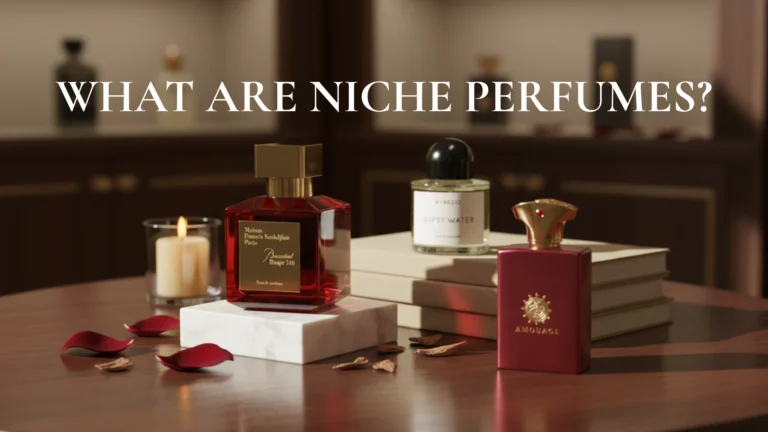 Education
Niche Perfumes: What They Are and Why They’re Worth Exploring
Read more → Education
Iso E Super in Perfumery: A Guide to the Ghost ingredient
Read more →
Scent Chronicles participates in affiliate programs. We may earn a commission on qualifying purchases made through links in this guide, at no additional cost to you. This never affects which fragrances we recommend or what we say about them. Read full policy →