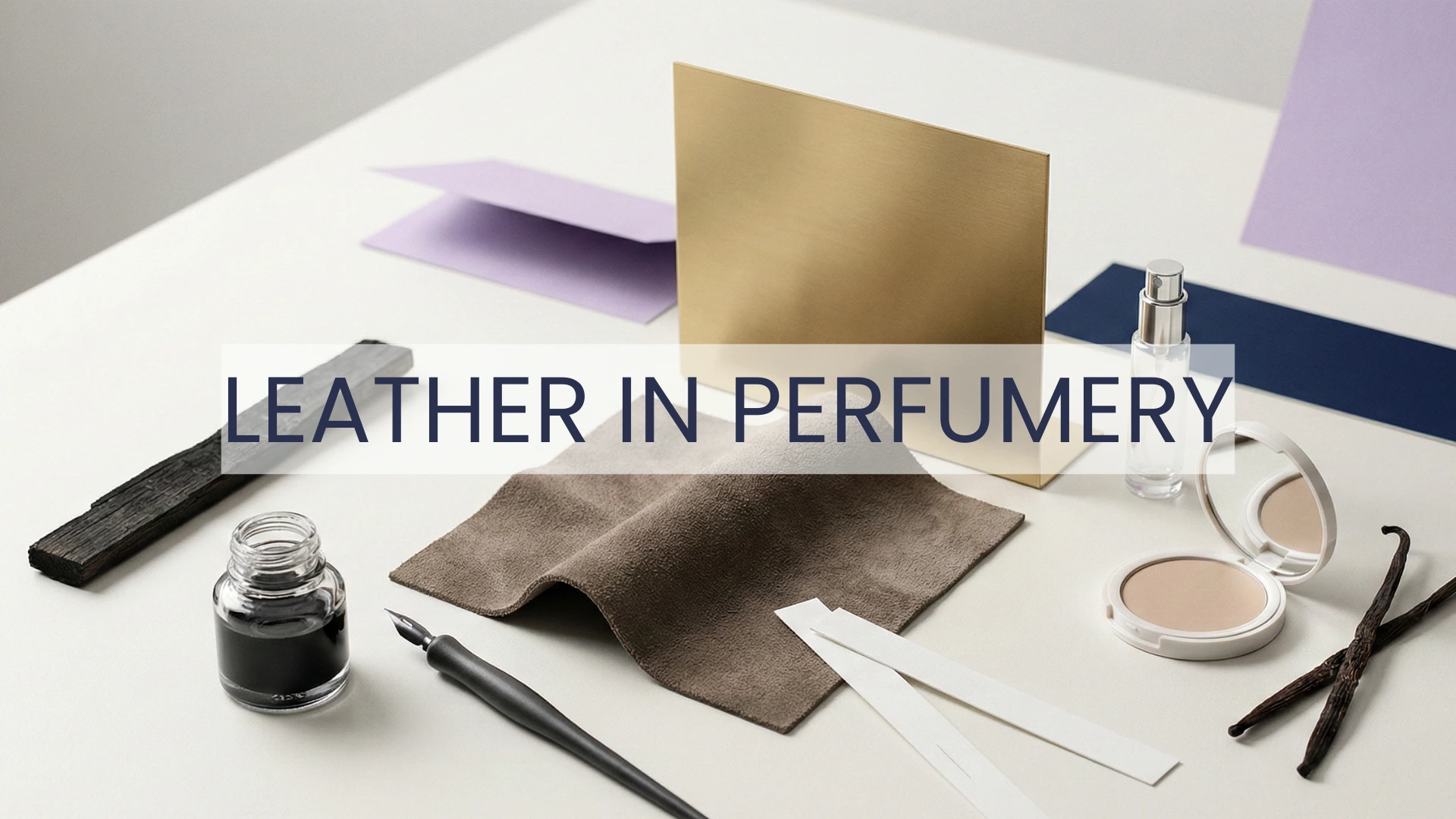
Leather in perfumery is one of the most distinctive aromatic categories and one of the most chemically complex. The note refers not to a single ingredient but to a category of aromatic compositions that recreate the smoky-tannic-warm character of cured leather using either natural materials (cade oil, birch tar, styrax) or synthetic aroma chemicals (suederal, isobutyl quinoline, IsoButavan). Modern leather perfumery covers a spectrum from clean-saddle (Tom Ford Ombré Leather) to smoky-birch-tar (Knize Ten) to powdery-suede (Bottega Veneta), and understanding the category is understanding why leather compositions read so distinctively grown-up.
Leather in perfumery is not a single ingredient. It is a compositional category covering smoky, suede, and saddle profiles.
- What it is: A compositional category recreating cured leather using natural and synthetic aromatic compounds.
- Where it lives: Tom Ford Ombré Leather, Knize Ten, Chanel Cuir de Russie, Bottega Veneta, Mancera Roses Vanille.
- Three profiles: Smoky-tannic (birch tar), Saddle-clean (synthetic suederal), Powdery-suede (iso-butyl quinoline).
What leather actually is in perfumery
Leather in perfumery vocabulary refers not to a single ingredient but to a category of aromatic compositions that recreate the smoky-tannic-warm character of cured leather. Modern leather perfumery uses three primary classes of materials: natural aromatics (birch tar, cade oil from juniper, styrax resin), synthetic aroma chemicals (suederal, isobutyl quinoline, IsoButavan), and structural blends that combine multiple compounds to produce specific leather profiles.
The category divides into three dominant compositional profiles. Smoky-tannic leather uses high concentrations of birch tar or cade oil to recreate traditional Russian-style leather (Knize Ten, Chanel Cuir de Russie). Saddle-clean leather uses synthetic suederal compounds for a softer, cleaner profile (Tom Ford Ombré Leather, Hermès Cuir d’Ange). Powdery-suede leather uses isobutyl quinoline for a refined, suede-coded character (Bottega Veneta, Tom Ford Tuscan Leather).
Birch tar (Betula pendula extract) was historically the foundation of leather perfumery, dating to 18th-century Russian leather-tanning techniques where birch tar was used to waterproof and preserve leather. Modern IFRA safety regulations have restricted birch tar concentration in commercial perfumery due to potential skin sensitisation, which is part of why most contemporary leather compositions rely more heavily on synthetic suederal and IsoButavan than on natural birch tar.
How leather behaves on skin
On skin, leather compositions develop slowly across the entire wear arc rather than blooming and fading like top or middle notes. The opening typically reads slightly polarising. Smoky and tannic in birch-tar compositions, slightly medicinal in synthetic-leather compositions. And softens within the first hour into a warm-leather character that anchors the rest of the composition.
Skin chemistry affects leather expression dramatically. Buyers with drier skin tend to experience leather compositions as cleaner and more architectural; buyers with oilier skin tend to experience the same compositions as warmer, smoother, and more sensual. The molecule’s tannic quality also responds to body temperature. Leather compositions amplify in warm conditions but can read overpowering on hot summer days, which is why most leather compositions are coded fall-winter or evening rather than year-round.
In compositions where leather plays a supporting role, you can usually identify it by behavioural pattern. The dry-down has a distinctive warm-tannic character that holds 8-12 hours of wear; the projection produces an “old-luxury” quality that observers describe as sophisticated rather than fresh; the overall composition reads as evening-coded and grown-up rather than youthful. Modern leather compositions in current production rely on this architectural distinctiveness for differentiation against the broader designer category.
A short history of leather in perfumery
Leather has been used in personal-fragrance contexts since at least the 17th century, when leather goods (gloves, handbags, accessories) were typically perfumed during manufacturing to mask the harsh tanning odours. The first major Western perfumery formulation explicitly built around leather was Knize Ten (1924), an Austrian composition that established the smoky-tannic Russian-leather profile as a luxury fragrance category in its own right.
Through the early-to-mid 20th century, leather remained a specialist note used in occasional luxury releases. Chanel Cuir de Russie (1924) and Caron Tabac Blond (1919) demonstrated that leather could anchor architectural compositions for both genders. The post-1940s era saw a gradual shift toward cleaner, more synthetic-blend-heavy leather compositions as IFRA safety regulations and consumer preferences moved away from the harsher birch-tar profiles of earlier decades.
The contemporary leather renaissance came with three specific releases. Tom Ford Tuscan Leather (2007) demonstrated that leather could anchor a luxury Western composition with broad consumer appeal; Bottega Veneta (2011) made suede-leather accessible to designer-tier feminine buyers; Tom Ford Ombré Leather (2018) established the modern saddle-clean leather template that has dominated post-2018 men’s niche perfumery. Today, leather appears in approximately 25% of niche-tier compositions launched since 2018, and the category covers a meaningfully wider spectrum than at any previous point in commercial perfumery.
How to recognize leather profiles
The fastest way to learn what leather smells like in perfumery is to wear three contrasting compositions back to back. Knize Ten demonstrates the smoky-tannic birch-tar profile in its purest commercial form. Tom Ford Ombré Leather Parfum demonstrates the modern saddle-clean synthetic-leather profile. Bottega Veneta EDP demonstrates the powdery-suede leather profile. Once you have all three references, you can identify leather variants in essentially any composition you encounter.
In compositions where leather plays a supporting role rather than as a primary anchor, you can usually identify it by behavioural pattern. The opening has a distinctive smoky or tannic edge; the middle phase develops a warm-leather quality that integrates with surrounding aromatic elements; the dry-down maintains a leathery-amber warmth that holds 8-12 hours. Most leather-anchored compositions follow this development arc reliably.
Distinguishing between birch-tar leather and synthetic-suederal leather takes a developed nose. Birch-tar compositions read smokier and more “campfire-adjacent”; synthetic-suederal compositions read cleaner and more architectural. Most modern compositions blend both for compositional balance. The polarising opening reads more architecturally interesting if anchored by birch tar; the daily-driver wearability reads more accessible if anchored by synthetic suederal. Buyers can build leather rotations around their preferred end of this spectrum.
Want to explore leather rotations?
If you have built reference points for leather as a compositional category, the natural next step is rotation-building. Our leather buying guide covers five contemporary leather compositions tested at the niche counter. From Tom Ford Ombré Leather Parfum’s saddle-clean luxury to budget-tier alternatives at meaningfully lower price points. Read the leather rotation guide →
Fragrances featuring leather, ranked across compositional profiles
Five well-known compositions covering the full leather spectrum, from smoky-tannic to saddle-clean to powdery-suede.
| Fragrance | Brand | Concentration | Role | Verdict |
|---|---|---|---|---|
Knize Ten View on Amazon → | Knize | Heavy | Smoky-tannic showcase | The 1924 Russian-leather reference. Birch-tar at full concentration. |
Ombré Leather Parfum View on Amazon → | Tom Ford | Heavy | Saddle-clean luxury | The modern saddle-clean leather reference. Cardamom-leather-jasmine architectural anchor. |
Tuscan Leather View on Amazon → | Tom Ford | Significant | Niche raspberry-leather | Raspberry-leather-saffron Private Blend reference. Polarising and architecturally distinctive. |
Bottega Veneta EDP View on Amazon → | Bottega Veneta | Heavy | Powdery-suede feminine | The powdery-suede feminine reference. Patchouli-leather architectural composition. |
Cuir d'Ange View on Amazon → | Hermès | Significant | Niche soft-leather | Jean-Claude Ellena's soft-leather composition. Hawthorn-iris-leather sophistication. |
“Leather in perfumery is not a single ingredient. It is a compositional category covering smoky, suede, and saddle profiles.
Rodrigo H. · Counter Notes
Leather is one of the most architecturally significant compositional categories in modern perfumery and one of the most spectrum-spanning. The same broad term can describe smoky-tannic Knize Ten, saddle-clean Tom Ford Ombré Leather Parfum, raspberry-leather Tuscan Leather, and powdery-suede Bottega Veneta. Four very different compositional experiences within a unified category vocabulary.
For first-time leather buyers, Tom Ford Ombré Leather Parfum is the right entry point. It provides architectural leather character in the most universally-flattering modern saddle-clean profile. For buyers ready to explore beyond the modern template, Knize Ten demonstrates the historical smoky-tannic baseline; Bottega Veneta demonstrates the powdery-suede feminine end; Tuscan Leather demonstrates niche-tier architectural distinctiveness. Build rotations across the spectrum rather than committing to a single profile.
Common questions
+What does leather smell like in perfume?
The category covers a spectrum. Smoky-tannic leather reads like campfire-adjacent traditional Russian leather (Knize Ten, Chanel Cuir de Russie). Saddle-clean leather reads like clean cured leather without the smoky edge (Tom Ford Ombré Leather). Powdery-suede leather reads soft, refined, and slightly cosmetic (Bottega Veneta). The cleanest reference is to wear all three back to back to learn the spectrum.
+Is birch tar safe in perfume?
In modern commercial perfumery, yes. At the concentrations permitted by current IFRA safety standards. Historical leather perfumery (pre-1990) used birch tar at significantly higher concentrations than current standards permit; some legacy compositions have been reformulated to comply with modern safety thresholds. The reformulated versions read slightly cleaner than the original 20th-century formulations but are otherwise architecturally similar.
+Are leather fragrances unisex?
Most are, with caveats. Saddle-clean leather (Tom Ford Ombré Leather, Hermès Cuir d’Ange) reads appropriately across genders. Smoky-tannic leather (Knize Ten, Chanel Cuir de Russie) skews slightly more masculine in the modern market but works on women with the right skin chemistry. Powdery-suede leather (Bottega Veneta) skews more femme-coded but is appropriate on men in evening contexts. The “feminine” or “masculine” coding of specific leather compositions depends on the surrounding architectural elements rather than on the leather itself.
+How do I know if a fragrance contains real leather?
No fragrance contains “real leather” in the literal sense. Leather is a compositional category that recreates the aromatic profile of cured leather using natural and synthetic aromatic compounds. The relevant distinction is between birch-tar-heavy compositions (more natural-traditional) and synthetic-suederal-heavy compositions (more modern-architectural). Most contemporary leather compositions blend both for compositional balance.
+Why are leather fragrances so polarising?
Three reasons. First, the smoky-tannic opening of birch-tar-heavy compositions can read off-putting to wearers without prior reference points. Second, leather compositions read evening-coded and grown-up, which can feel inappropriate for younger demographic buyers expecting fresh-or-floral compositions. Third, skin chemistry affects leather expression more dramatically than most aromatic categories, which means leather compositions produce more variable customer reactions than synthetic-amber-anchored compositions.
+Can I wear leather fragrances year-round?
Some yes (Tom Ford Ombré Leather Parfum, Bottega Veneta work in temperate spring and fall), some no (Knize Ten and Tuscan Leather are too dense for warm weather above 22°C). Best strategy: build a two-bottle leather rotation rather than expecting one bottle to handle all conditions. The right summer leather is lighter and cleaner; the right winter leather is denser and more smoky-tannic.
 Education
What Are Fragrance Families? A Simple Guide for Beginners
Read more →
How To Know Which Season A Fragrance Is Designed For
Read more → Education
What is Sillage in Perfumery? Definition and Meaning
Read more →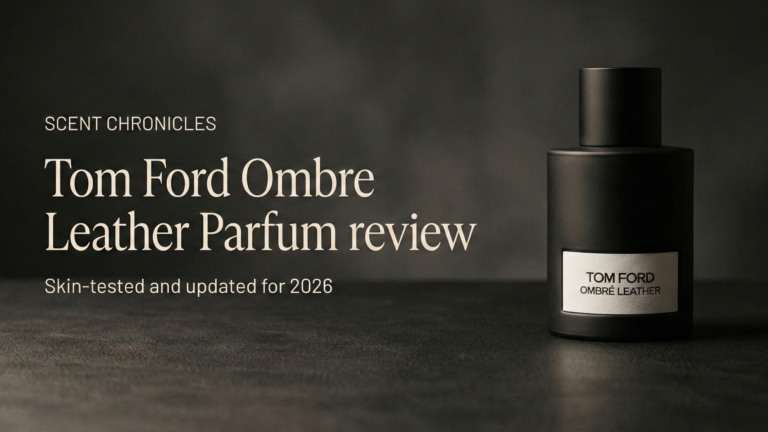 Review
Tom Ford Ombre Leather Parfum review 2026 – Leather Upgrade
Read more → Education
Iso E Super in Perfumery: A Guide to the Ghost ingredient
Read more →
Scent Chronicles participates in affiliate programs. We may earn a commission on qualifying purchases made through links in this guide, at no additional cost to you. This never affects which fragrances we recommend or what we say about them. Read full policy →