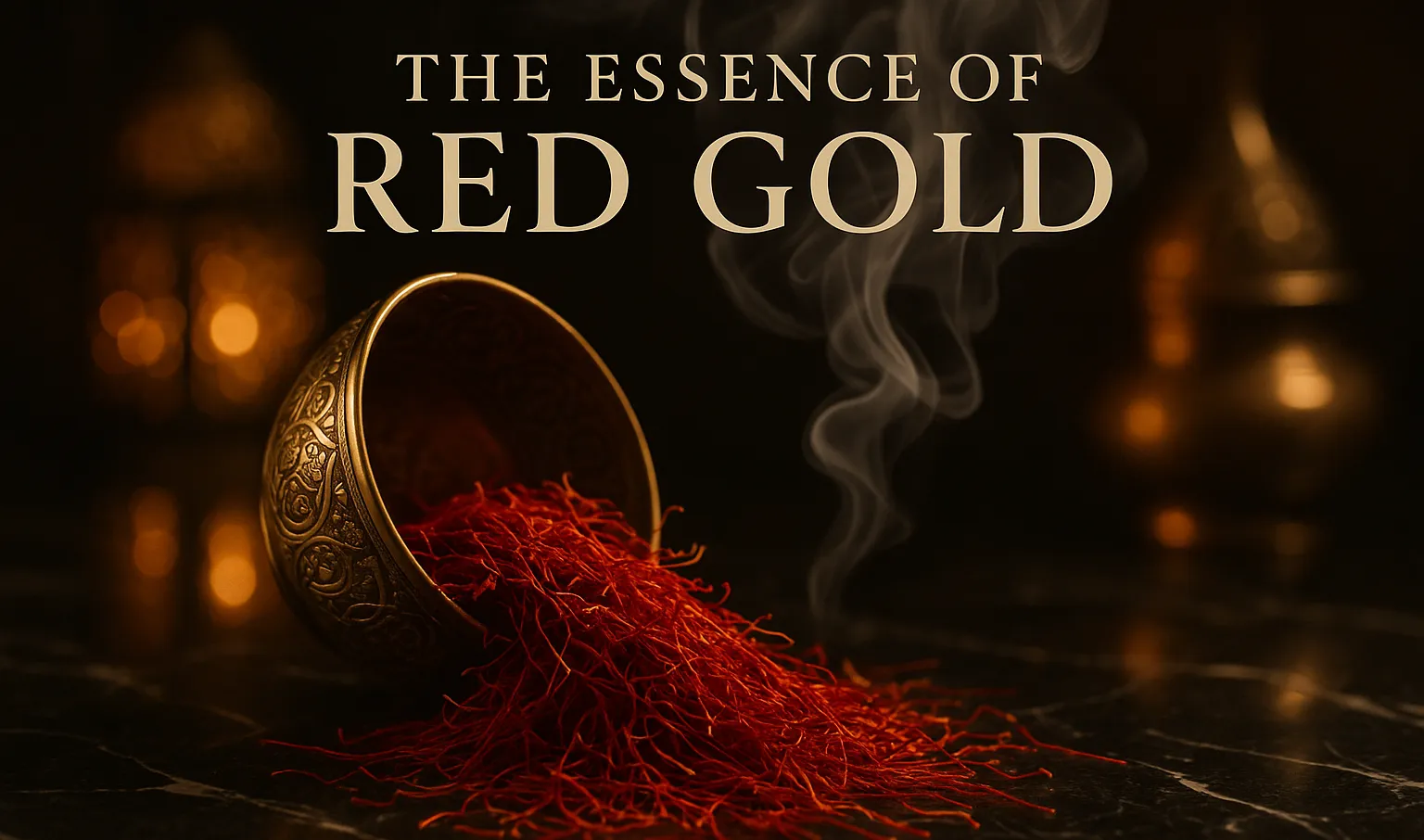
Saffron is the most expensive culinary spice in the world and one of the most distinctive aromatic ingredients in modern perfumery. Harvested from the dried stigmas of the Crocus sativus flower, saffron produces a leathery-honeyed-slightly-medicinal character that has anchored Middle Eastern perfumery for centuries and rebuilt modern Western niche perfumery in the past fifteen years. The defining commercial showcase is Maison Francis Kurkdjian Baccarat Rouge 540, which made saffron-jasmine-amber the dominant niche-tier composition profile of the 2020s.
Saffron costs more per gram than gold. Modern perfumery uses synthetic safranal alongside natural saffron absolute for cost-controlled architecture.
- What it is: Dried stigmas of Crocus sativus, source of safranal molecule and saffron absolute.
- Where it lives: Baccarat Rouge 540, Initio Oud for Greatness, MFK Grand Soir, Sauvage Elixir, Khamrah Maliky.
- Why it matters: Adds leathery-medicinal complexity that natural perfumery cannot replicate without it.
What saffron actually is
Saffron is harvested from the three red stigmas of the Crocus sativus flower, native to Greece and West Asia. Each flower produces approximately 30 milligrams of saffron stigma; producing one kilogram of dried saffron requires approximately 150,000-200,000 flowers harvested by hand. The labour intensity drives the price. Commercial-grade saffron sells for $5,000-15,000 per kilogram retail, making it more expensive per gram than gold.
In perfumery, saffron contributes through three primary aromatic compounds: safranal (the dominant aldehyde, producing the characteristic leathery-honeyed character), picrocrocin (responsible for the slightly bitter-medicinal note), and crocin (a carotenoid that contributes to the colour but not directly to the aroma). Most commercial perfumes use a blend of synthetic safranal, produced industrially at significantly lower cost, alongside small percentages of natural saffron absolute for full architectural complexity.
Natural saffron absolute costs approximately $30,000-50,000 per kilogram in commercial-grade purity, depending on origin (Iranian saffron is generally the highest-quality and most expensive; Spanish, Greek, and Indian Kashmir saffrons are also commercially traded at slightly lower price points). Synthetic safranal costs $200-500 per kilogram. The price gap explains why even niche-tier compositions usually use blends of synthetic safranal with small percentages of natural saffron absolute.
How saffron behaves on skin
On skin, saffron produces a distinctive leathery-honeyed character with slight medicinal undertones. The opening note can read polarising. Some wearers experience the medicinal-bitter edge as off-putting in the first twenty minutes. But the development arc softens within thirty minutes into a warm-honeyed leather that anchors the rest of the composition.
Saffron interacts strongly with surrounding ingredients in modern compositions. Saffron-jasmine pairings (Baccarat Rouge 540, Grand Soir) produce sweet-warm signatures; saffron-oud pairings (Initio Oud for Greatness) produce smoky-leather profiles; saffron-rose pairings (MFK Oud Satin Mood, Lattafa Asad) produce floral-leather signatures. The molecule’s versatility as a structural connector explains why it appears in such a wide range of niche-tier compositions.
Skin chemistry affects saffron expression dramatically. Buyers with drier skin tend to experience saffron as cleaner and more medicinal; buyers with oilier skin tend to experience the same compositions as warmer and more honeyed. This is part of why saffron-anchored compositions like Baccarat Rouge 540 produce such variable customer reactions. The architectural impression is consistent across wearers, but the dominant character note shifts noticeably from skin to skin.
A short history of saffron in perfumery
Saffron has been cultivated and used in cooking, medicine, and personal fragrance contexts for over three thousand years. Ancient Persian, Greek, and Indian civilisations all developed sophisticated saffron-based aromatic traditions, and Middle Eastern perfumery has used saffron continuously since at least the 9th century. The traditional Middle Eastern attar tradition (concentrated oil-based fragrance compositions) treats saffron as one of the four classical aromatic anchors alongside oud, amber, and rose.
Western perfumery largely ignored saffron until the 20th century. The first major Western luxury showcase was Caron Tabac Blond (1919), which used saffron alongside leather and tobacco to create one of the earliest leather-feminine compositions. Through the 1920s-90s, saffron remained a niche specialist note used in occasional luxury releases (Guerlain L’Heure Bleue, various Caron releases) without becoming a mainstream architectural element.
The post-2010 era has seen saffron become a defining note of modern niche perfumery. Maison Francis Kurkdjian Baccarat Rouge 540 (2015) demonstrated that saffron-jasmine-amber-cedar could produce a universally-flattering signature at niche-tier pricing; Initio Oud for Greatness (2018) showed how saffron-lavender openings could anchor oud-forward compositions for Western buyers. Today, saffron appears in approximately 60% of niche-tier compositions launched since 2018, and dominates the most-requested customer profiles at the niche counter.
How to recognize saffron on skin
The fastest way to learn what saffron smells like in perfumery is to wear Baccarat Rouge 540 for a day. The composition uses saffron at high enough concentrations to be reference-able, and the saffron-jasmine pairing demonstrates how the molecule connects floral and amber materials architecturally. The cleanest comparison reference is to wear a Middle Eastern attar at full saffron concentration (Mancera Aoud Saffron, Lattafa Asad) and a Western niche release (Baccarat Rouge 540, Initio Oud for Greatness) back to back to learn how the same molecule reads differently across compositional traditions.
In compositions where saffron plays a supporting role, you can usually identify it by behavioural pattern. The opening has a distinctive leathery-medicinal edge that lasts 15-30 minutes; the middle phase develops into warm-honeyed character; the dry-down maintains a leather-amber warmth that holds 8-12 hours. Most saffron-forward niche compositions follow this development arc reliably.
Distinguishing between natural saffron absolute and synthetic safranal takes a developed nose. Natural saffron reads more complex with subtle floral-bitter undertones; synthetic safranal reads cleaner and more linear. Most modern niche compositions blend both for compositional depth. Buyers who want a clean reference for natural saffron should sample directly: cooking-grade Iranian or Kashmiri saffron in warm water produces an aromatic infusion that demonstrates the natural material in isolation.
Want to understand another defining ingredient?
If saffron is the leathery-honeyed connector of modern niche perfumery, oud is the resinous-leather anchor that frequently pairs with it. Saffron-oud compositions account for approximately 30% of niche-tier releases since 2018; understanding both molecules is understanding the dominant niche-tier compositional template. Read the Oud guide →
Fragrances featuring saffron, ranked by how prominently it shows
Five well-known compositions where saffron plays a real structural role, ordered from most-prominent showcase to most-effective supporting role.
| Fragrance | Brand | Concentration | Role | Verdict |
|---|---|---|---|---|
Baccarat Rouge 540 View on Amazon → | Maison Francis Kurkdjian | Heavy | Saffron-jasmine showcase | The niche-tier saffron reference. Saffron-jasmine-amber-cedar architectural anchor. |
Oud for Greatness View on Amazon → | Initio | Significant | Saffron-oud opening | Saffron-lavender opening anchored on oud-amber base. The Western niche oud reference. |
Grand Soir View on Amazon → | Maison Francis Kurkdjian | Moderate | Saffron-amber binder | Saffron supporting amber-vanilla evening composition. |
Sauvage Elixir View on Amazon → | Dior | Moderate | Designer accent | Saffron contributing to spicy-amber daytime designer profile. |
Khamrah Maliky View on Amazon → | Lattafa | Significant | Budget saffron-rose | Budget-tier saffron-rose-tobacco composition. Khamrah line royal extension. |
“Saffron costs more per gram than gold. Modern perfumery uses synthetic safranal alongside natural saffron absolute for cost-controlled architecture.
Rodrigo H. · Counter Notes
Saffron has become the most architecturally significant niche-tier note of the post-2015 era, and the molecule that more than any other defines what “modern niche” smells like. The Baccarat Rouge 540 effect, making saffron-jasmine-amber the dominant niche-tier compositional template, has rebuilt the entire niche perfumery category around the molecule.
For most buyers, the right entry point into saffron is Baccarat Rouge 540 itself. For buyers who want a budget alternative, Khamrah Maliky and Lattafa Asad both use saffron credibly at meaningfully lower prices. For buyers ready to explore Middle Eastern attar tradition, Sultan Pasha and Ensar Oud both produce saffron-anchored compositions that demonstrate how the molecule has been used architecturally for centuries.
Common questions
+What does saffron smell like in perfume?
Leathery, honeyed, slightly medicinal in the opening, warming to amber-leather across development. The cleanest reference is to wear Baccarat Rouge 540 for a day, or to smell cooking-grade saffron infused in warm water for the natural-material baseline.
+Why is saffron so expensive in perfume?
Three reasons. First, each Crocus sativus flower produces only 30mg of saffron stigma. Producing one kilogram requires 150,000-200,000 hand-harvested flowers. Second, saffron extraction for perfumery (saffron absolute) requires solvent extraction at significant additional cost. Third, the natural complexity of saffron makes synthetic substitutes only partially adequate; even niche-tier compositions blend synthetic safranal with small percentages of natural saffron absolute.
+Is saffron safe in perfumery?
Yes. Saffron has been used safely in perfumery, cooking, and traditional medicine for over three thousand years. The aromatic compounds (safranal, picrocrocin, crocin) are well-characterised and the IFRA safety standards permit saffron and synthetic safranal at typical perfumery concentrations without restriction.
+How does saffron compare in Middle Eastern vs Western perfumery?
Middle Eastern attar tradition uses saffron at significantly higher concentrations than Western niche perfumery, often as a primary architectural anchor rather than as a supporting note. Western niche perfumery (Baccarat Rouge 540, Grand Soir, Initio Oud for Greatness) typically uses saffron at lower concentrations as a connector between dominant character notes.
+Are saffron fragrances unisex?
Yes. Saffron has been used across genders in Middle Eastern perfumery for centuries, and modern niche-tier saffron compositions are explicitly unisex (Baccarat Rouge 540, Initio Oud for Greatness, MFK Grand Soir all read appropriately on both men and women). The “feminine” or “masculine” coding of specific saffron compositions depends on the surrounding architectural elements rather than on the saffron itself.
+Should I buy real saffron perfume or synthetic-safranal alternatives?
For most buyers, blends with both are the right choice. Pure-natural saffron compositions exist (some Sultan Pasha and Ensar Oud attars) but tend to sit at $300-1,000+ price points where the cost-per-bottle math only works for collectors. Niche-tier blends (Baccarat Rouge 540, Grand Soir) and budget alternatives (Khamrah Maliky, Lattafa Asad) all produce credible saffron character at significantly more accessible price points.
 Education
Perfume Layering: The Complete Guide
Read more →
What is Oud in Perfumery? The Complete Guide
Read more → Education
What is Vanilla in Perfumery? A Guide to the Sweetest Note
Read more →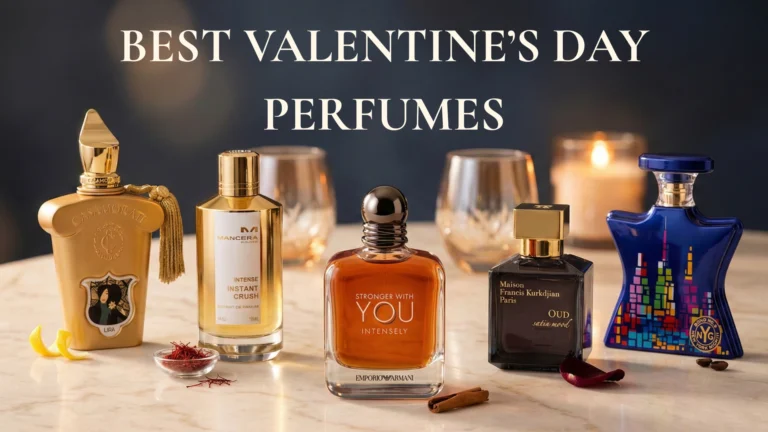 Occasion
5 Best Valentine’s Day Fragrances 2026 for Real Dates
Read more → Education
Iso E Super in Perfumery: A Guide to the Ghost ingredient
Read more →
Scent Chronicles participates in affiliate programs. We may earn a commission on qualifying purchases made through links in this guide, at no additional cost to you. This never affects which fragrances we recommend or what we say about them. Read full policy →