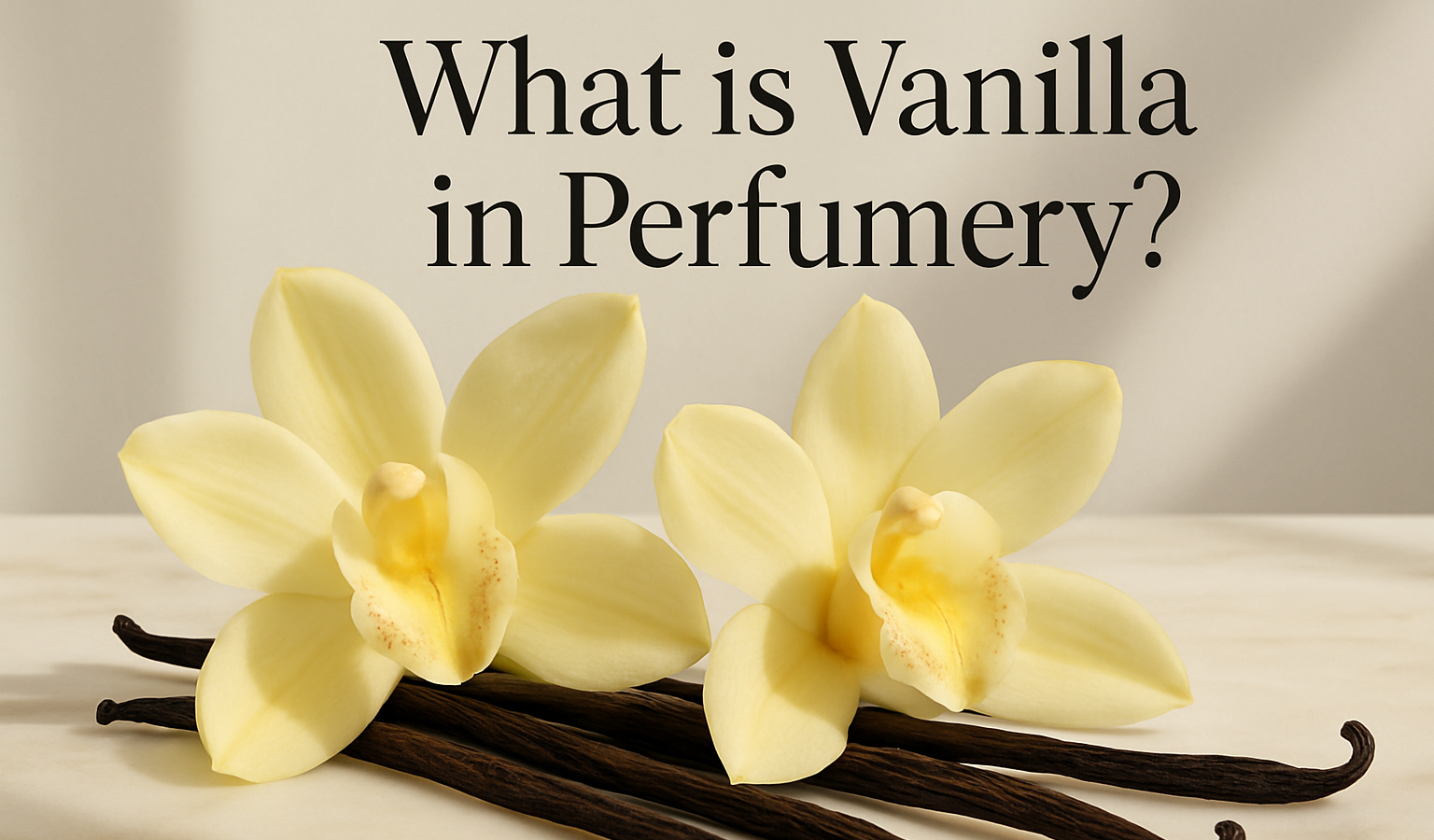
Vanilla is the most-used aromatic ingredient in modern perfumery. The cured pods of the Vanilla planifolia orchid produce vanillin and ethyl-vanillin. The molecules responsible for the warm-sweet-creamy character that has anchored gourmand perfumery since the 1980s. Most “vanilla” fragrances at the designer-tier level use synthetic vanillin and ethyl-vanillin almost exclusively rather than natural vanilla absolute, which is one of the most expensive natural perfumery materials in commercial production.
Vanilla is the most-used aromatic ingredient in modern perfumery. Most designer “vanilla” fragrances contain almost no natural vanilla.
- What it is: Cured Vanilla planifolia orchid pods, source of vanillin and ethyl-vanillin molecules.
- Where it lives: Tom Ford Tobacco Vanille, Sauvage Elixir, Khamrah, Cloud, and most cold-weather gourmands.
- Natural vs synthetic: Natural vanilla absolute costs $400-800/kg; synthetic vanillin costs $15-30/kg. Most commercial perfumes use synthetic.
For the women's-focused side of the note, see our best vanilla perfumes for women guide.
What vanilla actually is
Vanilla is harvested from the cured pods (commonly called “beans”) of the Vanilla planifolia orchid, native to Mexico and now cultivated primarily in Madagascar, Indonesia, and Tahiti. The defining aromatic molecule is vanillin, a phenolic aldehyde that produces the characteristic warm-sweet-creamy character, alongside ethyl-vanillin, a synthetic analogue that is roughly 3x more potent and slightly more “candy-like” in profile.
In commercial perfumery, the term “vanilla” describes a spectrum of materials. Vanilla absolute is the most expensive form, extracted from cured Madagascar or Tahitian pods through ethanol or hexane solvent extraction. Vanilla CO2 is a more recently-available extraction using supercritical carbon dioxide. Synthetic vanillin is the dominant industrial form, produced from petrochemical feedstocks or from lignin (a wood pulp byproduct). Most designer-tier fragrances use synthetic vanillin almost exclusively due to cost.
Natural vanilla absolute costs $400-800 per kilogram in commercial-grade purity, depending on origin and harvest year. Synthetic vanillin costs $15-30 per kilogram. The price gap explains why even niche-tier compositions usually use blends of synthetic vanillin with small percentages of natural vanilla absolute for character. Pure-natural vanilla compositions exist but tend to sit at $400-800 retail price points where the cost-per-bottle math works.
How vanilla behaves on skin
On skin, vanillin and ethyl-vanillin produce a warm-sweet-creamy character that intensifies with body heat. Cold-weather wear amplifies the molecules’ development arc. Vanilla in winter blooms gradually over six to ten hours, while vanilla in summer can read sticky-sweet within thirty minutes due to faster evaporation rates. This is why most serious vanilla compositions are coded fall-winter rather than year-round.
Skin chemistry affects vanilla expression less dramatically than chemistry-sensitive notes like oud or iso e super, but still meaningfully. Buyers with drier skin tend to experience vanilla compositions as cleaner and more architectural; buyers with oilier skin tend to experience the same compositions as warmer and sweeter. Ethnic and dietary differences in sebum composition produce additional variability, which is why vanilla compositions can read as universally-flattering on some wearers and saccharine on others.
In compositions where vanilla anchors the architecture rather than serving as a top-note, the molecule binds and rounds out other aromatic compounds. Tobacco-vanilla compositions (Tobacco Vanille, Khamrah Dukhan), oud-vanilla compositions (MFK Oud Satin Mood), and amber-vanilla compositions (Sauvage Elixir, Khamrah) all use vanilla as a structural softener that prevents the dominant character note from reading too aggressively. This is why vanilla appears in approximately 70% of cold-weather designer compositions in current production.
A short history of vanilla in perfumery
Vanilla’s entry into Western perfumery came through colonial trade routes from Mexico to Spain in the 16th century, then to France through the establishment of vanilla cultivation in French Réunion (formerly Île Bourbon) in the 19th century. The first major Western perfumery use was Guerlain Jicky (1889), which used both natural vanilla absolute and synthetic vanillin (newly available after the 1874 synthesis breakthrough by Wilhelm Haarmann and Ferdinand Tiemann).
The modern vanilla-anchored gourmand category began with Thierry Mugler Angel (1992), which used ethyl-vanillin at unprecedented commercial concentrations alongside synthetic patchouli-coumarin to produce the first deliberately “edible” feminine fragrance. Angel sold over $100 million in its first decade and established gourmand as a permanent perfumery genre. Within ten years, gourmand compositions had reorganised the entire feminine fragrance market.
The post-2010 era has seen vanilla cross from feminine-coded gourmand into masculine-coded composition. Tom Ford Tobacco Vanille (2007) made vanilla luxurious and evening-coded for men; Dior Sauvage Elixir (2021) made spicy-vanilla a daily-driver designer signature. Today, vanilla appears across the entire fragrance market. From $35 Lattafa releases to $400+ niche-tier compositions to natural-vanilla absolute compositions at niche-tier $500-800 price points.
How to recognize vanilla on skin
The fastest way to learn what synthetic vanilla smells like is to wear a high-vanilla designer composition for a day. Sauvage Elixir, Khamrah, and Tobacco Vanille all use vanilla at high enough concentrations to be reference-able in isolation. The cleanest reference is to compare two compositions: a synthetic-heavy designer (Khamrah) versus a natural-heavier niche bottle (MFK Grand Soir). The natural composition reads more complex, more architectural, and slightly less “sweet”; the synthetic composition reads more straightforward and more candy-coded.
In compositions where vanilla plays a supporting role, you can usually identify it by a behavioural pattern: the dry-down reads warmer and sweeter than the listed notes would predict, the composition holds longer than a non-vanilla equivalent, and the overall projection has a “binding” quality that prevents other notes from reading too aggressively. Most cold-weather designer compositions in current production use vanilla in this supporting-binder role.
Ethyl-vanillin specifically is identifiable by a more candy-coded sweetness than natural vanilla. Compositions heavy in ethyl-vanillin (Angel, Cloud, Sweet Tooth) read explicitly dessert-coded; compositions using natural vanilla absolute or vanilla CO2 read more architectural. The distinction matters for buyers building rotations: ethyl-vanillin compositions are generally more polarising and more youth-coded; natural-vanilla compositions read more grown-up and more universally-wearable.
Want to explore vanilla cold-weather rotations?
If you have built a reference for vanilla as an architectural ingredient, the natural next step is rotation-building. The five vanilla cold-weather compositions in our buying guide all use vanilla differently. From Tobacco Vanille’s tobacco-anchored interpretation to Sauvage Elixir’s spicy designer use. Read the vanilla cold-weather guide →
Fragrances featuring vanilla, ranked by how prominently it shows
Five well-known compositions where vanilla plays a real structural role, ordered from most-prominent showcase to most-effective supporting role.
| Fragrance | Brand | Concentration | Role | Verdict |
|---|---|---|---|---|
Tobacco Vanille View on Amazon → | Tom Ford | Heavy | Tobacco-vanilla anchor | The luxury vanilla reference. Tobacco-leaf and vanilla as co-architectural elements. |
Sauvage Elixir View on Amazon → | Dior | Significant | Spicy designer | The most universal vanilla designer. Spicy-vanilla-amber daily-driver. |
Khamrah View on Amazon → | Lattafa | Heavy | Budget masala vanilla | The budget vanilla. Niche-tier first impressions at $35. |
Cloud View on Amazon → | Ariana Grande | Heavy | Celebrity gourmand | Coconut-praline-vanilla-musk universal celebrity gourmand. Year-round capable. |
Grand Soir View on Amazon → | Maison Francis Kurkdjian | Significant | Niche evening polish | The niche-tier amber-vanilla. Evening-coded sophistication. |
“Vanilla is the most-used aromatic ingredient in modern perfumery. Most designer “vanilla” fragrances contain almost no natural vanilla.
Rodrigo H. · Counter Notes
Vanilla has become the structural anchor of modern cold-weather perfumery, and one of the most economically significant ingredients in the entire industry. The natural-versus-synthetic distinction matters less than for ingredients like oud. Synthetic vanillin and ethyl-vanillin produce highly-credible vanilla character that meets most buyer expectations.
For most buyers, the right vanilla strategy is to build a rotation that uses vanilla in different architectural roles. Tobacco-vanilla (Tobacco Vanille) for evening; spicy-vanilla (Sauvage Elixir) for daily; masala-vanilla (Khamrah) for budget; gourmand-vanilla (Cloud) for celebrity rotation; amber-vanilla (Grand Soir) for niche polish. Owning the same vanilla profile in five bottles is rotation fatigue; owning five different vanilla architectures is rotation versatility.
Common questions
+What does vanilla smell like in perfume?
Warm, sweet, creamy, slightly woody. Natural vanilla absolute reads more complex with subtle smoky-leathery undertones; synthetic vanillin reads cleaner and more straightforwardly sweet; ethyl-vanillin reads more candy-coded and more dessert-like. Most modern perfumes use blends of all three for depth.
+Is natural vanilla worth more than synthetic vanilla?
In niche-tier compositions, yes. Natural vanilla absolute adds compositional complexity that synthetic alternatives cannot fully replicate. In designer-tier compositions, the difference is largely indistinguishable to most buyers, and synthetic vanillin produces credible vanilla character at significantly lower cost. For buyers prioritising architectural distinctiveness, natural vanilla matters; for buyers prioritising daily-driver wearability, synthetic vanillin is more than adequate.
+Why is natural vanilla so expensive?
Three reasons. First, vanilla orchids must be hand-pollinated outside their native Mexican habitat. A labour-intensive process. Second, the curing process takes 6-9 months and requires careful management. Third, vanilla cultivation is climate-sensitive and harvests can vary 3-5x year-to-year due to weather. Madagascar produces approximately 80% of global vanilla and is increasingly affected by climate variability, which has driven prices up significantly since 2015.
+Are vanilla fragrances feminine?
No. Vanilla has been used across genders since perfumery began. Modern men’s fragrance has rebuilt around vanilla-anchored compositions since the late 2010s. Sauvage Elixir, Tobacco Vanille, and Layton are all heavily vanilla-anchored and read fully masculine in wear. The “feminine” association of vanilla descends from 1990s gourmand marketing rather than from anything inherent to the molecule.
+How long does vanilla last on skin?
Vanilla is a base note with high molecular weight, which means it holds longer than top or middle notes. Vanilla compositions in EDP concentration typically project for 8-12 hours, with detectable dry-down sometimes lasting 24+ hours on clothing. Cold weather amplifies vanilla longevity; warm weather shortens it.
+Can I wear vanilla year-round?
Some compositions yes (Layton, Cloud, Grand Soir all work year-round in temperate climates), some no (Tobacco Vanille, Khamrah Dukhan are too dense for warm weather above 22°C). Best strategy: build a two-bottle vanilla rotation rather than expecting one bottle to handle all conditions. The right summer vanilla is lighter and brighter; the right winter vanilla is denser and warmer.
How To Know Which Season A Fragrance Is Designed For
Read more → Education
What Is Saffron in Perfumery? The Golden Spice of Fragrance
Read more → Education
What is Sillage in Perfumery? Definition and Meaning
Read more → Occasion
10 Best Perfumes Under in 2026 – Affordable Scents That Smell Expensive
Read more → Education
Iso E Super in Perfumery: A Guide to the Ghost ingredient
Read more →
Scent Chronicles participates in affiliate programs. We may earn a commission on qualifying purchases made through links in this guide, at no additional cost to you. This never affects which fragrances we recommend or what we say about them. Read full policy →