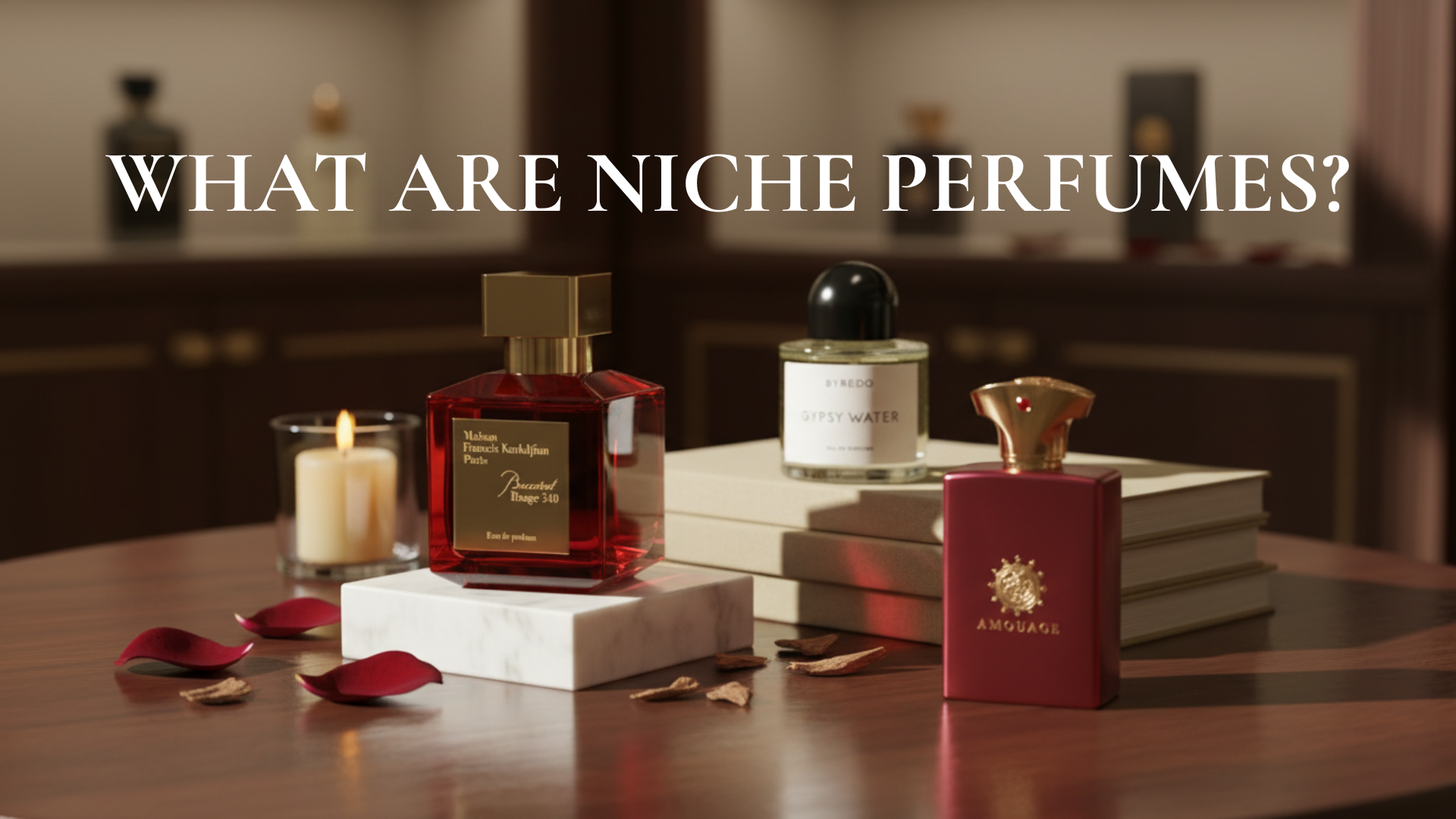
Niche perfumery is the segment of the fragrance industry that prioritises architectural distinctiveness, higher natural-ingredient concentrations, and deliberately limited distribution over mainstream commercial reach. The category covers houses like Maison Francis Kurkdjian, Initio, Parfums de Marly, Le Labo, Diptyque, Hermès, and Tom Ford’s Private Blend line. Understanding what distinguishes niche from designer perfumery, and what does not, is essential for anyone building a serious fragrance rotation beyond mainstream retail.
Niche is not always better than designer. It is differently architectural, differently priced, and differently distributed.
- What it is: Fragrance segment prioritising architectural distinctiveness over mainstream commercial reach.
- Price tier: Typically $200-500 for 100ml EDP; some $500-1,000+ ultra-premium tiers exist.
- Distribution: Specialty retailers (Bergdorf, Saks, brand boutiques), not mass-market department stores.
What niche perfumery actually is
Niche perfumery describes the segment of the fragrance industry that prioritises architectural distinctiveness, higher natural-ingredient ratios, longer compositional development time, and deliberately limited distribution over mainstream commercial reach. The category emerged in the late 20th century as a counter-positioning to mass-market designer perfumery, which had become dominated by synthetic-heavy compositions optimised for blind-test consumer appeal rather than for architectural distinctiveness.
There is no formal industry definition of niche, but the working definition rests on four characteristics: price ($200-500+ for 100ml EDP, compared to $60-150 for designer), distribution (specialty retailers and brand boutiques, not mainstream department stores), compositional priority (architectural distinctiveness over universal appeal), and house structure (independently-owned or boutique-positioned, not part of major fashion conglomerates). Houses meeting three or four of these characteristics are typically classified as niche.
The category has expanded significantly since 2010. Major fashion conglomerates have launched “niche” sub-lines (Tom Ford Private Blend, Chanel Les Exclusifs, Dior La Collection Privée) that occupy the same price tier and distribution model as independent niche houses while remaining attached to mainstream commercial parent organisations. Whether these conglomerate sub-lines qualify as “true niche” is debated; for practical buying purposes, they share most of the architectural and compositional characteristics of independent niche perfumery.
How niche differs from designer
On skin, niche compositions typically project further per spray than designer alternatives, hold longer through the dry-down arc, and reveal more architectural complexity in the middle phases of wear. Most niche-tier EDP compositions hold for 8-12 hours; most designer-tier EDP compositions hold for 6-8 hours. Niche-tier compositions also reward longer wear-tests. The architectural distinctiveness reveals across multiple wearings rather than landing immediately on first encounter.
The natural-versus-synthetic ingredient distinction matters more in niche than in designer perfumery. Most designer compositions use 90%+ synthetic aromatic compounds; most niche compositions use 30-60% natural materials blended with structural synthetics. The higher natural ratio produces more compositional complexity but also more skin-chemistry variability. Niche compositions can read more dramatically different across individual wearers than designer compositions.
Price is not always proportional to compositional quality. Some designer compositions (Bleu de Chanel EDP, Sauvage Elixir, Tom Ford Tobacco Vanille) compete architecturally with niche-tier alternatives at meaningfully lower prices. Some niche compositions are over-priced for what they deliver. The right buying strategy is to evaluate each composition on its own architectural merit rather than trusting that “niche” automatically equals better. Sample before committing, particularly above $200.
A short history of niche perfumery
The niche perfumery category emerged in the 1970s-80s with the launch of Annick Goutal (1981), Diptyque (1968. Though their fragrance line came later), and Creed’s repositioning as a luxury house. Through the 1990s, additional brands launched (Comme des Garçons Parfums, Miller Harris, L’Artisan Parfumeur) and the category began to coalesce as a distinct alternative to mainstream designer perfumery.
The major expansion came with three specific brand launches in the 2000s. Le Labo (2006), Maison Francis Kurkdjian (2009), and Initio (2015) established the contemporary niche-tier template. Limited distribution, premium price tier, architectural distinctiveness, and high natural-ingredient ratios. Parfums de Marly (relaunched in 2009) and Mancera (2008) extended the category at slightly more accessible price points.
Today the niche perfumery category accounts for approximately $3-5 billion in annual global sales. A small share of the total fragrance market but the fastest-growing segment. The category has also absorbed traditional Middle Eastern attar perfumery into Western retail through houses like Mancera, Lattafa, and Swiss Arabian, which produce niche-architectural compositions at meaningfully lower prices than Western niche houses. The convergence has expanded what “niche” means and made architectural niche-tier compositions accessible to buyers across a broader price spectrum.
How to identify a niche house
Distribution is the most reliable indicator. Niche houses sell through Bergdorf Goodman, Saks Fifth Avenue, Bloomingdale’s premium fragrance halls, brand boutiques, and high-end specialty retailers. Mainstream department stores (Macy’s, JCPenney) and mass-market retailers (Walmart, Amazon-direct) do not stock niche-tier brands. Sephora occupies a middle position. They carry some niche-tier sub-brands (Maison Margiela Replica, Tom Ford Private Blend) but not most independent niche houses.
Price tier is the second indicator. Most independent niche houses start their entry-level 100ml EDP releases at $200+ and frequently extend to $400-500 for line flagships. Designer-tier compositions rarely exceed $200 for equivalent volume. Major exceptions exist (Tom Ford Private Blend at $300+, Chanel Les Exclusifs at $300+) where conglomerate brands occupy niche-equivalent pricing.
Compositional priority is the third indicator and the most subjective. Niche compositions prioritise architectural distinctiveness; designer compositions prioritise universal appeal and blind-test commercial success. Reading composition descriptions and ingredient lists can reveal architectural priority. Niche compositions typically emphasise distinctive single-note anchors and complex middle-phase development, while designer compositions emphasise compliment-magnet projection and accessible top-note appeal. The distinction takes practice to identify reliably.
Want to find your signature scent?
If you understand the distinction between niche and designer perfumery, the natural next step is identifying which compositions match your specific preferences. The signature-scent guide covers the framework I use at the niche counter to help buyers identify their own architectural priorities. Read the signature scent guide →
“Niche is not always better than designer. It is differently architectural, differently priced, and differently distributed.
Rodrigo H. · Counter Notes
The niche-versus-designer distinction matters less for first-time fragrance buyers than the marketing suggests. Both categories produce excellent compositions; the right buying strategy is to evaluate each release on architectural merit rather than to trust that the niche label automatically signals quality.
For buyers building their first serious rotation, start with designer-tier daily-drivers (Bleu de Chanel EDP, Sauvage Elixir, Coco Mademoiselle EDP) and graduate to niche-tier compositions only after building reference points. The price tier matters because over-spending on niche-tier compositions you do not actually wear daily produces buyer fatigue. Architectural distinctiveness rewards long-term wearers, but only if the bottle is worn rather than displayed.
For a seasonal angle, see our best spring niche perfumes guide.
Common questions
+What makes a perfume niche?
Four characteristics: price ($200-500+ for 100ml EDP), distribution (specialty retailers and brand boutiques rather than mass-market department stores), compositional priority (architectural distinctiveness over universal appeal), and house structure (independently-owned or boutique-positioned). Houses meeting three or four of these characteristics are typically classified as niche.
+Is niche perfume worth the price?
For year-round daily-drivers, generally yes. Niche compositions typically project further per spray, hold longer through the dry-down arc, and reveal more architectural complexity over multi-wear evaluation. The price-per-wear math justifies the niche tier when the bottle becomes a daily-driver. For occasional-use bottles, the math is less favourable; sample before committing to $200+ purchases.
+How does niche differ from designer in performance?
Niche compositions typically project further per spray and hold longer through the dry-down arc. Most niche-tier EDP compositions hold for 8-12 hours; most designer-tier EDP compositions hold for 6-8 hours. Niche compositions also reward longer wear-tests. The architectural distinctiveness reveals across multiple wearings rather than landing immediately.
+What are the best niche perfume houses?
For most Western buyers, the strongest niche houses are Maison Francis Kurkdjian, Initio Parfums Privés, Parfums de Marly, Le Labo, Diptyque, and Hermès. For Middle Eastern niche perfumery at meaningfully lower prices, Mancera, Lattafa, and Swiss Arabian all produce architecturally credible compositions.
+Are conglomerate "niche" sub-lines really niche?
Debated. Tom Ford Private Blend, Chanel Les Exclusifs, and Dior La Collection Privée occupy the same price tier and distribution model as independent niche houses, and they share most of the architectural characteristics of independent niche perfumery. Whether they qualify as “true niche” depends on how strict the independence definition is. For practical buying purposes, the architectural quality is comparable.
+Can I find niche perfume on Amazon?
Limited and risky. Most niche houses do not authorise Amazon distribution; bottles available through Amazon are typically grey-market or counterfeit. Avoid Amazon third-party sellers without clear brand-direct attribution for niche purchases. The right purchasing channels are brand boutiques, Bergdorf Goodman, Saks, Bloomingdale’s premium fragrance halls, FragranceNet, and Beautylish.



Scent Chronicles participates in affiliate programs. We may earn a commission on qualifying purchases made through links in this guide, at no additional cost to you. This never affects which fragrances we recommend or what we say about them. Read full policy →