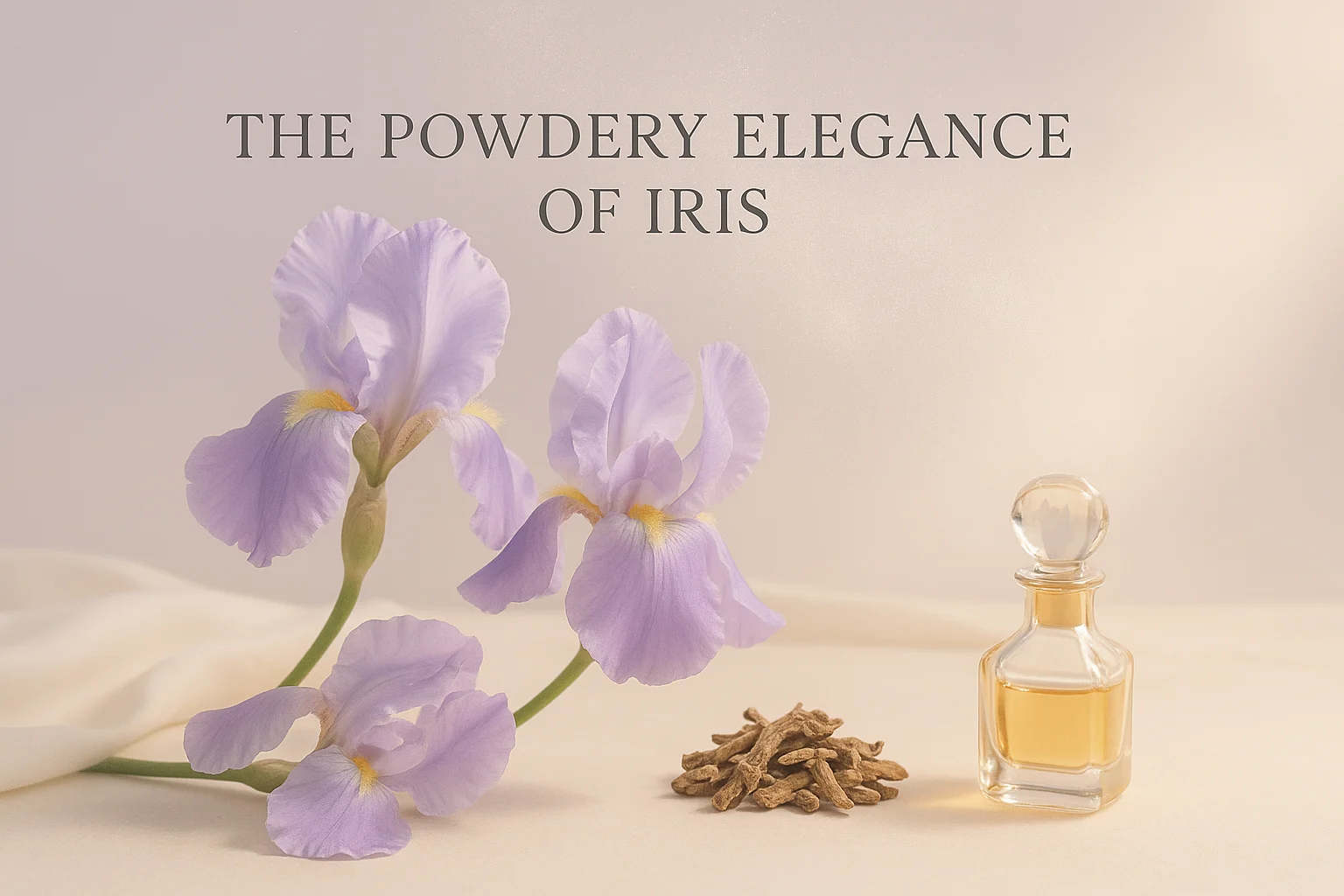
Iris in perfumery refers not to the flower but to the root of the Iris pallida or Iris germanica plant, harvested and aged for several years before yielding orris butter. One of the most expensive natural materials in commercial perfumery. The processing produces a powdery-elegant character with cool-violet undertones that has anchored luxury feminine and unisex perfumery for over a century. The defining contemporary showcase is Prada Infusion d’Iris, which made architectural iris compositions accessible to modern designer buyers.
Iris in perfumery is harvested from the root, not the flower. The aging process takes 3-5 years before extraction begins.
- What it is: Aged rhizomes of Iris pallida or germanica, source of orris butter (irones).
- Where it lives: Prada Infusion d’Iris, Chanel No. 19, Dior Homme, Hermès Hiris, Penhaligon’s Iris Prima.
- Why it matters: Produces powdery-elegant character that synthetics only partially replicate.
What iris actually is
Iris in perfumery vocabulary refers to the rhizome (underground stem) of the Iris pallida or Iris germanica plant, harvested at maturity and aged for three to five years before processing. The aging process is essential. Fresh iris rhizomes have almost no perfumery interest, but aged rhizomes develop concentrations of irones, the aromatic compounds responsible for the characteristic powdery-violet character.
After aging, the rhizomes are ground and steam-distilled to produce orris butter (or iris concrete). A waxy yellow-orange material that contains 8-15% irones by weight. The remaining material is typically discarded or used in industrial applications. Producing one kilogram of orris butter requires approximately 800-1,200 kilograms of fresh iris rhizomes plus three to five years of cultivation and aging time, which drives the cost. Orris butter sells for $80,000-150,000 per kilogram depending on purity and origin.
Most commercial perfumes use either pure orris butter (in luxury and niche compositions) or synthetic irones (in designer and mass-market compositions). The synthetic alpha-irone, beta-irone, and gamma-irone molecules reproduce approximately 60-70% of the natural orris butter aromatic profile but lack some of the architectural complexity of the natural material. For most architectural iris compositions (Prada Infusion d’Iris, Chanel No. 19, Dior Homme), small percentages of natural orris butter are blended with significant synthetic irone to control cost while preserving compositional complexity.
How iris behaves on skin
On skin, iris produces a distinctive cool-powdery character with subtle violet-buttery undertones. The opening reads cool and slightly elegant, almost makeup-like in its powdery quality, and the development arc maintains the powdery character across 4-8 hours of wear. Unlike most florals, iris does not “bloom” or amplify with skin warmth; instead, it sits cool and architecturally distinctive, which is part of why iris compositions read as polished and grown-up rather than romantic or ornamental.
Skin chemistry affects iris expression less dramatically than chemistry-sensitive notes like oud or musk, but still meaningfully. Buyers with drier skin tend to experience iris as cleaner and more powdery; buyers with oilier skin tend to experience the same compositions as warmer and slightly creamier. The molecule’s cool-mineral character also responds to ambient temperature. Iris compositions read more crisp in cool conditions and slightly muted in hot weather.
In compositions where iris plays an anchor role rather than a supporting note, the molecule produces a “carrot-pea-violet” architectural impression that is distinctively iris and not easily mistaken for any other natural material. This carrot-pea quality (technically irone-derived) explains why some buyers find iris polarising. The cool-vegetal undertone reads as elegant to some wearers and as off-putting to others. Iris-anchored compositions reward longer wear-tests than most other natural materials.
A short history of iris in perfumery
Iris cultivation for perfumery began in 16th-century Italy, particularly in Tuscany around Florence (Iris pallida cultivation), and in 17th-century France, particularly in Grasse (Iris germanica cultivation). The two regional traditions still dominate commercial orris production today. Tuscan orris is generally considered the highest-quality and most expensive, while French orris produces slightly lighter aromatic profiles at marginally lower cost.
The first major modern Western perfumery use of iris was Houbigant Quelques Fleurs (1912), which used orris butter alongside multiple natural florals in one of the earliest mass-market floral compositions. Chanel No. 19 (1971) demonstrated that iris could anchor a green-floral architectural composition rather than serving only as a powdery-decorative element. Through the late 20th century, iris remained primarily a luxury feminine note used in occasional couture releases.
The contemporary iris renaissance came with three specific releases. Hermès Hiris (1999) by Olivia Giacobetti demonstrated that iris could anchor architectural compositions at niche-tier pricing. Prada Infusion d’Iris (2007) by Daniela Andrier brought iris to designer-tier accessibility and made architectural iris compositions available to mainstream buyers. Dior Homme (2005) by François Demachy demonstrated that iris could anchor a polished men’s designer composition without reading feminine. Today, iris appears across the entire price spectrum. From $80 designer compositions (Prada Infusion d’Iris) to $300+ niche compositions (Penhaligon’s Iris Prima, Chanel 28 La Pausa).
How to recognize iris on skin
The fastest way to learn what iris smells like in perfumery is to wear Prada Infusion d’Iris for a day. The composition uses iris at high enough concentrations to be reference-able, and the cool-powdery development arc demonstrates the architectural character of the molecule clearly. The cleanest comparison reference is to compare two compositions: a designer iris (Prada Infusion d’Iris) versus a niche iris (Hermès Hiris or Chanel 28 La Pausa) back to back to learn how natural orris butter reads compared to synthetic-iridone-heavy compositions.
In compositions where iris plays a supporting role, you can usually identify it by behavioural pattern. The opening has a distinctive cool-powdery edge; the middle phase develops carrot-pea-violet architectural complexity; the dry-down maintains a powdery-warm quality that holds 4-8 hours. Most modern architectural iris compositions follow this development arc reliably.
Distinguishing between natural orris butter and synthetic irones takes a developed nose. Natural orris reads more complex with subtle leathery-buttery undertones; synthetic irones read cleaner and more linear. Most modern compositions blend both for compositional depth. Buyers who want a clean reference for natural orris should look at niche-tier compositions where the budget allows for higher orris-butter ratios. Hermès Hiris, Chanel 28 La Pausa, and Penhaligon’s Iris Prima all sit in this tier.
Want to understand another natural material?
If iris is the cool-powdery elegance of luxury perfumery, vanilla is its warm-sweet counterpart that frequently anchors complementary compositional architectures. Iris-vanilla pairings (Dior Homme, Chanel 28 La Pausa) account for some of the most-architecturally-distinctive luxury compositions of the past two decades. Read the Vanilla guide →
Fragrances featuring iris, ranked by how prominently it shows
Five well-known compositions where iris plays a real structural role, ordered from most-prominent showcase to most-effective supporting role.
| Fragrance | Brand | Concentration | Role | Verdict |
|---|---|---|---|---|
Infusion d'Iris View on Amazon → | Prada | Heavy | Iris showcase | The accessible iris reference. Architectural iris-incense composition. |
Hiris View on Amazon → | Hermès | Heavy | Niche iris showcase | Olivia Giacobetti's niche iris architectural reference. Cooler and more transparent than Prada. |
Dior Homme View on Amazon → | Dior | Significant | Iris-vanilla men's | Iris-vanilla men's architectural composition. Polished and grown-up. |
Iris Prima View on Amazon → | Penhaligon's | Heavy | Niche iris-amber | Iris-amber-leather niche composition. Evening-coded and architecturally distinctive. |
28 La Pausa View on Amazon → | Chanel Les Exclusifs | Significant | Luxury iris-vetiver | Cool-iris-vetiver architectural composition. The luxury iris reference. |
“Iris in perfumery is harvested from the root, not the flower. The aging process takes 3-5 years before extraction begins.
Rodrigo H. · Counter Notes
Iris is one of the most architecturally distinctive natural materials in modern perfumery and one of the most under-appreciated by mainstream buyers. The cool-powdery character that iris produces is genuinely difficult to replicate with synthetic alternatives, which is why orris butter remains commercially valuable despite its extraordinary cost.
For first-time iris buyers, Prada Infusion d’Iris is the right entry point. It provides architectural iris character at designer-tier pricing and works across daytime and casual contexts. For buyers ready to explore niche-tier iris, Hermès Hiris and Chanel 28 La Pausa both demonstrate how natural orris butter elevates compositional complexity. Iris compositions reward longer wear-tests than most other categories; sample before committing to full-size purchases above $200.
Common questions
+What does iris smell like in perfume?
Cool, powdery, slightly violet-buttery, with subtle carrot-pea undertones in higher-concentration compositions. The cleanest reference is to wear Prada Infusion d’Iris for a day, or to smell pure orris butter at a niche perfumery counter for the natural-material baseline.
+Why is iris so expensive in perfume?
Three reasons. First, iris rhizomes must be aged for three to five years before they develop perfumery interest. This is mandatory cultivation time, not optional. Second, producing one kilogram of orris butter requires approximately 800-1,200 kilograms of fresh rhizomes plus the multi-year aging process. Third, irones (the dominant aromatic compounds) are present at only 8-15% by weight in the final orris butter. The cumulative cost makes orris butter one of the most expensive commercial natural perfumery materials at $80,000-150,000 per kilogram.
+Are iris fragrances feminine?
Iris has been used across genders since perfumery began. Modern men’s fragrance has rebuilt around iris-anchored compositions since the 2000s. Dior Homme, Prada Infusion d’Iris (the men’s version), Tom Ford Italian Cypress, and Atelier Cologne Iris Rebelle all use iris architecturally and read fully masculine in wear. The “feminine” association of iris descends from 1970s couture marketing rather than from anything inherent to the molecule.
+How does iris differ from violet?
Closely related but architecturally distinct. Iris in perfumery refers to orris butter from iris rhizomes, producing a powdery-cool architectural character with subtle violet-buttery undertones. Violet in perfumery refers to leaves or flowers of the Viola odorata plant, producing a sweeter, more floral, more straightforwardly green character. Many iris compositions also include violet for structural complexity, but the two are not the same molecule or material.
+How long does iris last on skin?
Iris is a base-note material with high molecular weight, which means it holds longer than top or middle notes. Iris compositions in EDP concentration typically project for 6-10 hours, with detectable dry-down sometimes lasting 12+ hours. Cool weather amplifies iris longevity; warm weather slightly shortens it. Iris-vanilla compositions (Dior Homme, Chanel 28 La Pausa) hold longest of any iris architecture.
+Should I buy synthetic-iris or natural-orris compositions?
For most buyers, blends with both are the right choice. Pure-natural orris compositions exist (some Penhaligon’s and Chanel Les Exclusifs releases) but tend to sit at $250-500+ price points where the cost-per-bottle math only works for collectors. Designer-tier blends (Prada Infusion d’Iris) and niche-tier blends (Hermès Hiris) all produce architecturally credible iris character at significantly more accessible price points.
 Education
What is Sillage in Perfumery? Definition and Meaning
Read more → Education
What Is Ambroxan in Perfumery? A Complete Guide
Read more → Education
What Are Fragrance Families? A Simple Guide for Beginners
Read more →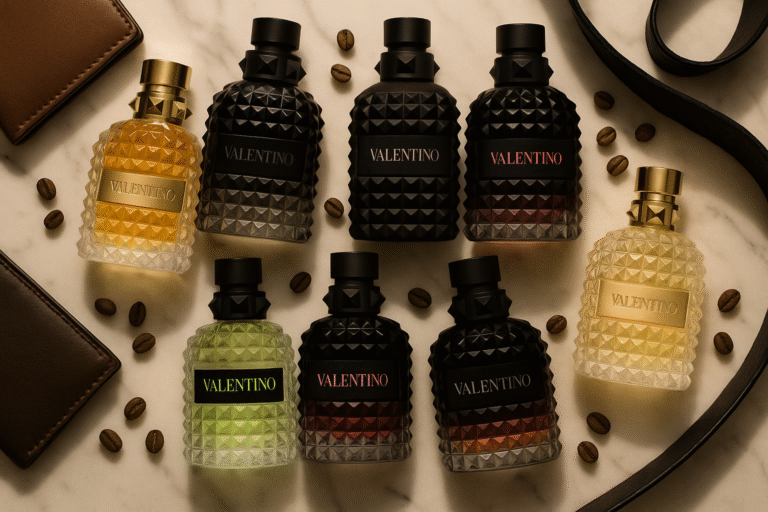 Guide
GuideValentino Perfumes Buying Guide for Men
Read more → Education
Iso E Super in Perfumery: A Guide to the Ghost ingredient
Read more →
Scent Chronicles participates in affiliate programs. We may earn a commission on qualifying purchases made through links in this guide, at no additional cost to you. This never affects which fragrances we recommend or what we say about them. Read full policy →